
Temporary power for a building site: pole or generator
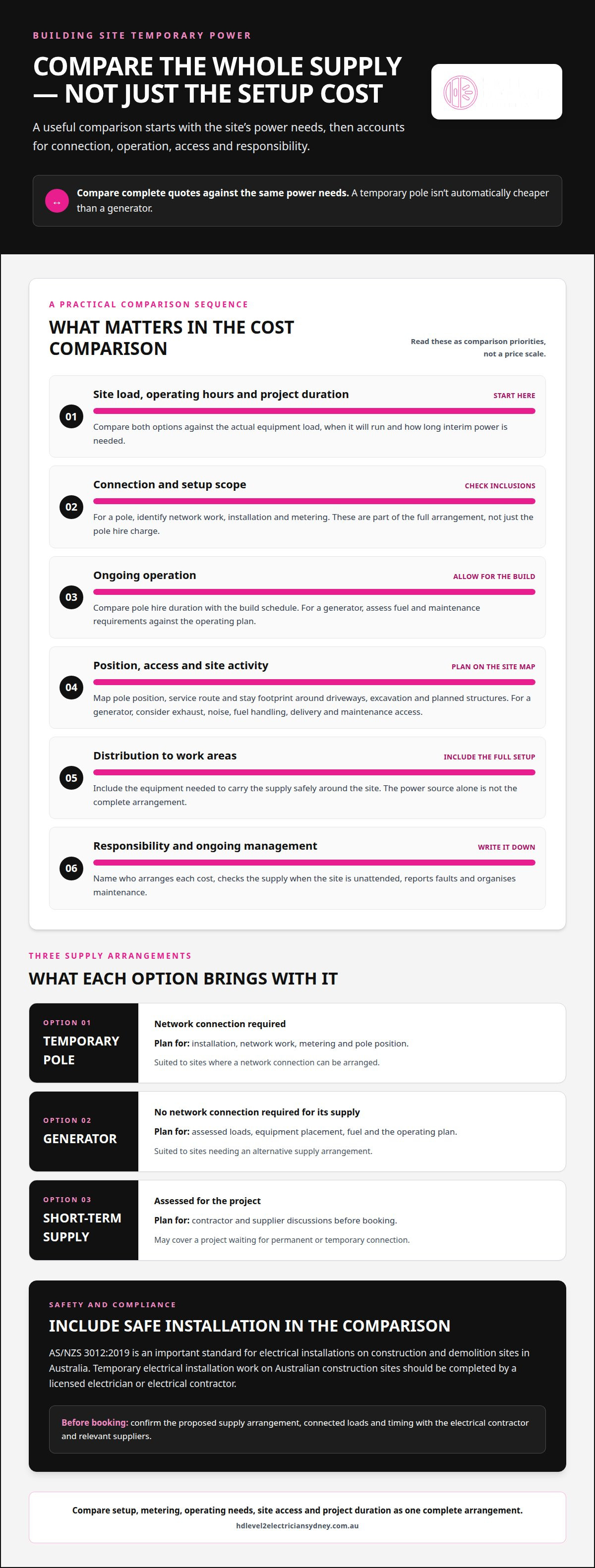
A temporary power pole isn’t automatically cheaper than a generator. The cost of temporary power for a building site depends on the site’s load, operating hours and project duration, as well as connection, installation, fuel and maintenance costs. Compare complete quotes against the same power needs before deciding.
It’s easy to focus on setup costs and overlook what it takes to keep power available throughout the build. A pole requires a network connection, installation, network work and metering. A generator needs to suit the connected loads and operating plan.
This guide explains how to assess site loads, compare pole and generator costs, and plan safe power distribution around a building site. It covers practical details that affect the choice, including equipment placement, site access, fuel handling and the work schedule, so you can compare options against how the project will run.
Key Takeaways
• Compare a temporary pole and generator using the site’s actual load, operating hours and project duration, not upfront cost alone.
• Factor in the full arrangement: a pole needs network connection, installation, network work and metering before it can supply power.
• Assess generator capacity and fuel needs against the equipment that will run and its expected operating load.
• Plan equipment placement, access, fuel handling and site power distribution around the construction work and safety needs.
• Use an electrical contractor to assess the supply arrangement and connected loads, particularly while waiting for a network connection.
Interim power arrangements while awaiting a connection
Across Australia, costs vary with the network work required, distributor requirements and site conditions. Location also affects the connection route and access. Compare the full supply arrangement, including setup, metering, operating needs and how long the site requires interim power.
A temporary pole needs a network connection, installation, network work and metering before it can supply power. If a connection isn’t available, a generator or separately assessed short-term supply may cover the gap.
Connection poles and site infrastructure
A temporary power pole provides a connection point for the site supply, but relies on network access and installation work. Its position needs to suit the service route while leaving space for the pole’s stay, construction activity and vehicle access. A generator doesn’t need the same network connection, but still requires a suitable position and an assessed connection to site wiring.
Before work starts, mark the proposed pole position on the site plan and compare it with the build sequence. Changes to access or nearby work can affect where infrastructure can go and how power reaches work areas.
Pole hire and connection costs
Pole hire and network connection are separate parts of the arrangement. The total depends on the connection and installation work required, metering, site access and how long temporary supply is needed. State, distributor and site location affect the connection process and practical work involved, so there is no single price for every Australian site.
A pole’s price depends on the work involved and is provided after a quote request. Cost factors include network work, installation, metering, hire duration and site access. Compare the full scope, not the hire charge alone.
| Option | Network connection | Key planning factors | Best suited to |
|---|---|---|---|
| Temporary pole | Required | Installation, network work, metering and pole position | Sites where a network connection can be arranged |
| Generator | Not required for its supply | Assessed loads, placement, fuel and operating plan | Sites needing an alternative supply arrangement |
| Short-term supply | Assessed for the project | Contractor and supplier planning before booking | Projects waiting for permanent or temporary connection |
Connection timing depends on the work required before the supply can be switched on. Allow for the connection process, installation, network work and metering, and sequence those steps around site access and the build program. Confirm the arrangement and timing with the electrical contractor and relevant suppliers before booking interim supply.
If a network connection isn’t available, an electrical contractor should assess the proposed generator system and its connected loads. A separately assessed short-term supply may cover the wait, but confirm the arrangement with the contractor and suppliers before booking.
Plan how the supply will be managed as well as which equipment will be used. Identify who checks it when the site is unattended, reports faults and arranges maintenance. Clear responsibilities help keep the interim arrangement managed as work progresses.
Choose the option that suits network access, required loads, project duration and site layout, then compare its complete setup and operating requirements.
What belongs in the cost comparison?
Compare the full temporary supply arrangement, not just equipment hire or installation. Break out setup, network work, metering, operating costs and site-specific work so the project budget shows what each quote includes.
Responsibility for temporary power costs depends on the project agreement and who arranges each part of the supply. The builder, owner or another agreed party may manage different charges. Don’t assume the electricity retailer covers installation or site infrastructure. List each cost and assign it to a named party before work begins.
Include safety and compliance in the comparison. AS/NZS 3012:2019 is an important standard for electrical installations on construction and demolition sites in Australia. Temporary electrical installation work on Australian construction sites should be completed by a licensed electrician or electrical contractor. Construction and demolition sites should have temporary electrical installations planned, installed and maintained with safety in mind.
Placement affects the work required and how safely the site can operate. For a temporary pole, map the service route, pole position and stay footprint against driveways, excavation areas and planned structures. For a generator, assess exhaust, noise and fuel handling, as well as delivery and maintenance access. A position that blocks truck access or conflicts with construction can disrupt the work sequence.
Connection and setup
identify network work, installation and metering included in the pole quote.
Hire and operation
compare the hire period with the expected build schedule, and include generator fuel and maintenance requirements.
Site access
note truck routes, working space, fuel access and any construction activity near the supply equipment.
Power distribution
include the equipment needed to carry supply safely to work areas, rather than treating the source alone as the full setup.
Responsibility
record who arranges each item, manages faults and organises maintenance while the site operates.
Use a written scope for each option. For example, if a pole quote includes installation but excludes network work or metering, record those items separately before comparing totals. If generator operation depends on site load, plan fuel use around that load rather than a generic hourly estimate.
Compare practical disruption as well as the quoted amount. A pole route that clashes with excavation, or a generator position that complicates fuel handling, can force changes to site planning. Review placement, access and electrical safety alongside the complete quote, then assign each cost and operating task clearly.
Temporary Power Pole or Generator for a Building Site?
A temporary power pole and a generator address different supply needs. Compare each against the site’s actual load, operating hours and project duration, then assess the complete arrangement rather than choosing on setup cost alone.
| Option | Connection needs | Cost factors | Planning considerations |
|---|---|---|---|
| Temporary power pole | Network connection, installation, network work and metering | Connection scope, installation and duration of use | Service route, pole position, stay footprint and access |
| Generator | Assessed connection to site wiring | Equipment suitability, actual load, fuel and maintenance | Exhaust, noise, fuel handling and placement |
| Combined arrangement | Assessed network and generator components | Costs of each supply component and operating period | Clear operating plan and suitable electrical connection |
Temporary power pole
A pole may suit a site where a network connection is available and can support the planned work. Compare its full connection scope, including installation, network work and metering. Consider the service route and pole footprint alongside the build layout. If excavation, deliveries or construction will affect the position, account for those site constraints.
Generator
A generator may suit a site without a suitable network connection or where another supply arrangement is needed. An electrical contractor should assess the generator system and connected loads. Base fuel estimates on the actual operating load, not a generic fuel-per-hour figure. Include operating hours, fuel handling, equipment placement, noise and exhaust in the project comparison.
Combined or interim supply
A project may use a separately assessed short-term supply while awaiting a permanent or temporary network connection. A combined arrangement can involve multiple supply components, so compare the scope and operating responsibilities for each. Confirm the arrangement with the contractor and suppliers before booking. Include who checks equipment when the site is unattended, reports faults and arranges maintenance.
Neither a pole nor a generator guarantees uninterrupted power. Treat continuity as an operating-planning issue: identify which work depends on supply, who responds to faults and how the site will manage an interruption. Have any connection between a generator and site wiring professionally planned. Improvised connections can create hazards and disrupt work.
Choose a temporary pole when network access, connection timing and the site layout support that option. Choose a generator when its assessed capacity and operating requirements suit the loads and work schedule. Consider a combined interim arrangement if the project needs a planned transition between supplies. In every case, compare complete quotes against the same loads, operating hours and project duration.
Assessing site power needs and load
Start with an equipment register rather than guessing the building site’s total demand. List every item requiring power, where crews will use it and which construction stage needs it. For example, the list could include a site office, work lights, a saw, a pump and battery chargers. An electrical contractor can use the schedule to assess supply against the site’s actual needs.
Next, identify which equipment may run at the same time. A saw, pump and chargers operating together create a different demand from equipment used in sequence. Include shared facilities such as lighting and site offices, not just high-demand tools. Note planned changes too: excavation, framing and fit-out may each involve different equipment and operating patterns.
Build a practical load schedule
Record each item’s nameplate details and expected use, then group equipment by location and construction stage. Separate continuous needs, such as site-office equipment, from intermittently used tools. Note equipment that may start while other loads are running. This gives the electrical contractor a clearer picture than a list without timings or work context.
Inventory
list tools, pumps, lighting, chargers and site-office equipment.
Use pattern
note where each item runs and whether it operates continuously or intermittently.
Overlap
identify combinations crews may use simultaneously, such as a saw and dust-control equipment.
Project stages
update the schedule when the work changes from ground preparation to construction or fit-out.
Site layout
map where crews need supply, so distribution planning reflects actual work areas.
Equipment nameplates help ground the assessment in the manufacturer’s stated requirements. Share those details and the work schedule with the electrical contractor. Where generator supply is being considered, the contractor can assess the connected loads and proposed generator system. For a network-connected arrangement, the load schedule also helps clarify the site’s supply needs.
Don’t size a generator using a generic fuel-per-hour estimate. Fuel use depends on the actual operating load, so the equipment list and expected work pattern matter when budgeting. A generator selected for occasional tool use may not suit a stage when pumps, lighting and work equipment overlap. Conversely, assuming every listed item runs continuously can misrepresent the site’s real demand.
Review the schedule when site operations change. Adding a pump or moving work to another area, for example, can alter demand or supply distribution. Give the electrical contractor updated equipment and usage details before changing the supply plan. A clear load assessment makes it easier to compare options against actual operating needs, rather than assumptions that distort costs.
Distributing power around a construction site
A supply point is useful only if power can reach the crews and equipment that need it. Plan distribution from the temporary supply to each work area, taking account of the site layout and construction sequence. For example, a saw near framing work and lighting in a site office need accessible supply points that don’t obstruct vehicle routes.
Start with a marked site plan. Locate the supply source, work zones, access ways, storage areas and areas where construction will move. Then mark where tools, pumps, chargers and lighting will be used at each project stage. This shows where distribution routes need to reach and where changing site activity may affect them.
Connections between a generator and site wiring should never be improvised. An electrical contractor should plan and complete the arrangement, matching the connection to the supply and connected loads. AS/NZS 3012:2019 is an important standard for electrical installations on construction and demolition sites in Australia. Plan, install and maintain temporary electrical installations with site safety in mind.
Plan routes around changing work
Map each route against truck access, material deliveries and active construction areas. A cable route across a driveway, for example, may conflict with deliveries or moving equipment. Show how the route avoids work areas and how crews can reach supply points without disrupting traffic or construction tasks.
Review the layout as work changes. A route that suits early site preparation may no longer work once framing, excavation or fit-out begins. Update the distribution plan before relocating equipment or changing the supply path to keep the arrangement aligned with work in progress.
Include distribution in the cost comparison rather than comparing only the pole or generator. The site may need multiple supply points, longer routes or layout changes as work areas shift. Assess each option against the same zones and equipment schedule. This gives a more useful comparison than a source-only quote that leaves distribution requirements out.
Mark work areas
show where crews will use tools, lighting and other equipment.
Trace routes
map the path from the supply source to each planned work zone.
Identify conflicts
note driveways, deliveries, excavation and changing construction activity.
Plan for stages
review routes when the project moves into new work areas.
Use an electrical contractor
have connections and site wiring professionally planned, not improvised.
Assign responsibility for checking equipment, reporting faults and arranging maintenance while the site is unattended. Record the process in the operating plan, including who responds when crews report a problem. Clear roles help the site manage distribution changes and faults without leaving equipment unchecked.
Before work begins, compare the marked layout with the planned loads and site access. Resolve route conflicts, confirm supply points and document who manages ongoing checks. A distribution plan based on real work zones gives the project team a practical way to coordinate temporary power as construction progresses.
High Demand Electrical: Level 2 ASP Electrical Services
High Demand Electrical provides Level 2 ASP Electrical Services for electrical infrastructure and supply work. If your project requires a private power pole, its team can install one as part of planning the site’s connection. This is relevant when the proposed supply route, pole position or site layout needs professional electrical assessment.
For a building project, clear information helps define the work. Share the site plan, expected equipment loads and construction schedule. High Demand Electrical also provides switchboard upgrades and consumer mains installation, which may suit broader supply infrastructure needs. The right scope depends on the electrical work required for the property and project.
To discuss electrical infrastructure for your project, contact High Demand Electrical or visit hdlevel2electriciansydney.com.au.
Set your site up for the next stage
Before your project moves to its next stage, turn the power plan into a clear scope of work. Assessing temporary power for a building site means considering the project requirements alongside the cost, so you can choose an arrangement that supports the build.
High Demand Electrical offers Level 2 ASP Electrical Services, Private Power Pole Installation and Switchboard Upgrades for relevant electrical infrastructure needs. These services can help when the next step involves planning a pole installation or addressing site supply infrastructure. The scope should reflect the work your project requires.
Contact High Demand Electrical to discuss the electrical work for your project. With a clear plan, you can move forward with greater confidence.
Frequently Asked Questions
Do I need a licensed electrician for temporary power on a construction site?
Yes. Temporary electrical installation work on Australian construction sites should be completed by a licensed electrician or electrical contractor. This includes planning and connecting site wiring, not just positioning equipment. For example, a generator supplying a site distribution board needs an assessed connection to the wiring and connected loads. Keep the installation plan aligned with the equipment schedule and update it as work areas change.
How long does it take to get a temporary builders supply connected?
The connection schedule depends on the network work, installation and metering required, as well as site access and readiness. A pole cannot supply power until those steps are complete. To plan the build sequence, identify the proposed connection point, ensure the site is accessible for the work, and coordinate supply steps with the construction program. A separately assessed interim supply may be considered while a connection is pending.
What standard applies to temporary power on construction sites in Australia?
It provides a useful reference when planning temporary site installations, including power distribution across work areas. The installation plan should also consider how the site operates, where equipment will be used and how the arrangement will be maintained as construction progresses.
How much does temporary power for a building site cost in Australia?
The cost of temporary power for a building site depends on the supply arrangement, actual loads, operating hours and project duration. A complete comparison also includes connection work, installation, metering, fuel, maintenance and site distribution. The price depends on the work involved and is provided after a quote request. Separate setup costs from ongoing operation to see how each option fits the project schedule.
What are typical temporary electricity connection and disconnection fees in Australia?
There isn’t one fee for every Australian site. Connection and disconnection charges relate to the work and network process involved, while electrical installation is a separate part of the scope. For a useful budget, distinguish network charges from electrician work, metering and site-specific changes. Record who manages each item so charges aren’t overlooked or counted twice.
How much does a temporary builder’s switchboard or site power pole cost to hire or buy?
Hire and purchase costs vary with the equipment, duration, connection requirements and site conditions, so one figure won’t describe every project. For a pole, include installation, network work and metering in the comparison. For a switchboard, consider how it fits the planned site supply and distribution. Compare the full scope and duration rather than treating the equipment price as the total cost.
What ongoing electricity supply charges and usage rates apply to temporary construction power?
Ongoing expenses can include electricity use and supply charges under the applicable electricity arrangement. Usage depends on the site’s operating load and hours, so a site running pumps and tools for longer will use power differently from one with intermittent equipment use. Track the equipment schedule and actual operating pattern when budgeting, and keep these figures separate from one-off connection and installation work.
What approvals, permits and inspections are required for temporary construction power in Australia?
Plan the connection through the relevant network process, and have temporary electrical installation work completed by a licensed electrician or electrical contractor. The work plan should identify the supply arrangement, site layout, connected loads and metering steps. Include any inspections and approvals required for the installation in the project sequence, alongside access for network work. This gives the site team a clear path from planned supply to power being available for construction.
Need Help Fast?
Powering Your Needs with Expertise
If you’re looking for a reliable, experienced, and prompt electrician, look no further than High Demand Electrical. We cater to all your electrical needs, from routine maintenance to emergency repairs and complete system installations. Our skilled team is committed to providing professional service that ensures your electrical systems run smoothly. Whether it's a small task or a large project, give us a call today. Let us meet all your electrical demands with the quality and reliability you deserve.

