Same Day Electrical Defect Rectification in Sydney
Can you stay home while an electrical defect is being rectified? It depends on the fault and work required. Repairs may involve a temporary power interruption, and the affected area must be made safe. If you need same day electrical defect rectification in Sydney, understanding the notice and repair process helps you act promptly and know what to expect.
An electrical defect notice identifies a fault or non-compliance that needs attention. Where the defect involves the electrical network or mains connection, only a Level 2 Accredited Service Provider is authorised to carry out the repairs. The notice also sets out what needs to be addressed and the relevant timeframe, so it’s important to take it seriously.
This guide explains what an electrical defect notice means, how repairs can affect staying at home, and what happens after the work, including testing and notification to the electricity distributor. It also covers how safety concerns shape the repair process, so you can understand the steps towards having the defect cleared.
Key Takeaways
• Read the defect notice carefully to identify the fault, the required action and the timeframe for responding.
• Whether you can remain at home during repairs depends on the hazard and work involved; some jobs may require a temporary power interruption.
• Understand how assessment, repair testing and distributor notification fit together, and what may happen before a notice is cleared.
• Recognise warning signs such as damaged poles, exposed cables or vegetation close to overhead power lines so you can respond promptly.
• Know when a defect involves network infrastructure or mains connections, and why that affects who can carry out the repair.
Level 2 electrician repairs and distributor notification
Defect rectification may involve electrical repairs, switchboard work or mains connections. The notice identifies the fault and outlines the required repairs and reporting steps.
Repair deadlines and disconnection risk
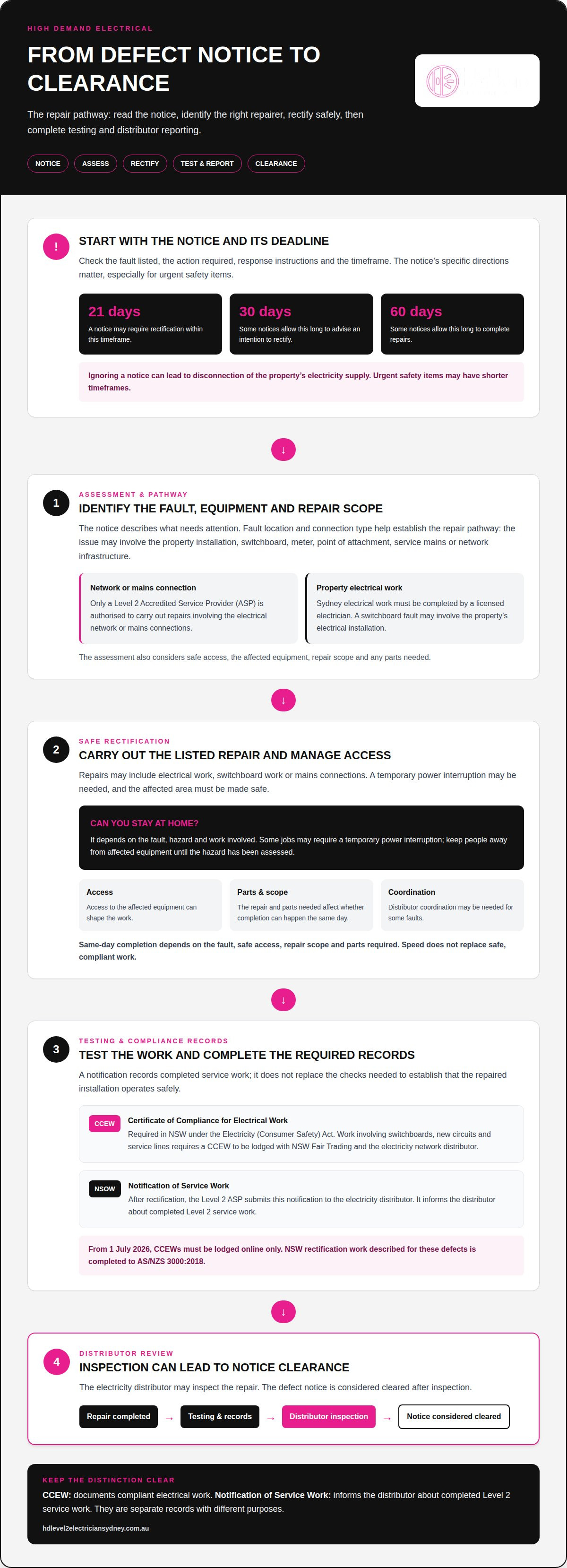
Check the notice for the listed defect, response instructions and deadline. In NSW, a notice may require rectification within 21 days; some notices provide 30 days to advise an intention to rectify and 60 days to complete repairs. Urgent safety items may have shorter timeframes, so the notice’s specific directions matter.
Ignoring a notice can lead to disconnection of the property’s electricity supply. If the defect involves the network or mains connection, only a Level 2 Accredited Service Provider is authorised to carry out the repair. A defect notice rectification service addresses the listed issue and the distributor’s notification process.
Repair testing and certification
After rectification, the Level 2 ASP submits a Notification of Service Work to the electricity distributor. The distributor may inspect the repair, and the notice is considered cleared after inspection. A notification records completed service work; it does not replace the checks needed to establish that the repaired installation operates safely.
In NSW, a Certificate of Compliance for Electrical Work is required under the Electricity (Consumer Safety) Act. From 1 July 2026, these certificates must be lodged online only. Work involving switchboards, new circuits and service lines requires a CCEW to be lodged with NSW Fair Trading and the electricity network distributor.
Qualifications and NSW compliance requirements
Sydney electrical work must be completed by a licensed electrician. For defects involving the electrical network or mains connections, the repair must be completed by a Level 2 Accredited Service Provider, whose authority covers this infrastructure work.
NSW rectification work described for these defects is completed to AS/NZS 3000:2018. The CCEW documents compliant electrical work, while the Notification of Service Work informs the distributor about completed Level 2 service work. These are separate records serving different compliance and network-notification purposes.
Defects rectifiable on the same day
Same-day completion depends on the fault, access to the affected equipment, the repair scope and the parts needed. A straightforward repair to an accessible connection may involve fewer steps than replacing damaged mains or upgrading a switchboard. An assessment identifies the necessary work and whether testing and required notifications can follow.
Metering faults and point of attachment defects can involve equipment connected to the supply network, so a Level 2 ASP may be required. Switchboard upgrades may also be necessary if the existing board contributes to the defect. Resolving these issues can also benefit future energy projects, as installers such as Sky High Solar and Electrical often require updated, compliant switchboards prior to connecting residential solar panel systems. The notice’s fault description, the condition of the electrical system and the work required determine the repair pathway.
Sydney service coverage
In Sydney, a defect’s location and connection type help determine the repair pathway. Network and service mains faults need attention from an appropriately authorised Level 2 ASP.
Service mains and network defect rectification
Level 2 ASP work covers defects involving the electrical network or mains connections. This can include service mains that connect a property to the supply network, whether overhead or underground. The repair pathway depends on the fault’s position, the condition of the connection and whether network equipment is affected. For a mains issue, [Level 2 electrical services](https://hdlevel2electriciansydney.com.au/level-2-electrician-sydney) are relevant to identifying and rectifying the infrastructure defect.
A fault at a switchboard may instead involve the property’s electrical installation. Where the issue involves a network connection, work must be carried out by a Level 2 Accredited Service Provider. Clear information about the affected equipment and the notice helps establish the scope before repairs begin.
Emergency electrical services
For active flame, dense smoke or immediate danger to life, call 000. Stay clear of fallen power lines and damaged electricity network infrastructure, then contact the electricity distributor. These steps take priority over arranging routine defect work because the immediate hazard may involve public infrastructure or a serious electrical risk.
Even an urgent defect notice requires a planned repair process. The notice identifies the required work, while the fault location and equipment access shape the response. Repairs may require a temporary power interruption. Keep people away from affected equipment until the hazard has been assessed.
High Demand Electrical works across Sydney, but the equipment involved matters as much as the property’s location. An overhead service connection presents different access conditions from underground mains. A pole, point of attachment, meter or switchboard can also affect the work required. These details help determine the right technical pathway.
Same-day or urgent rectification depends on the fault, safe access, required parts and whether distributor coordination is needed. An accessible visible defect may follow a different sequence from damaged underground connections. The repair still requires appropriate testing and reporting. Speed does not replace safe, compliant work.
For a time-sensitive notice, have the defect description, property location and relevant access details ready. This helps clarify whether the issue concerns service mains, network infrastructure or equipment within the property. If you need to discuss the work required, contact High Demand Electrical.
Fault assessment and diagnostic testing
A symptom can point to a problem, but an assessment identifies its source. Flickering lights, repeatedly tripping breakers, a faulty meter or damaged wiring can indicate different defects. The electrician reviews the notice, affected equipment and visible conditions before determining the necessary repairs and tests.
Assessment can also distinguish faults in property wiring from problems with connected appliances. For example, a breaker tripping when one appliance operates does not, by itself, show whether the appliance or circuit is faulty. A licensed electrician can assess the relevant circuit and connection. Household appliance repair is separate from rectifying defects in fixed wiring or network equipment.
For a reported overhead defect, the assessment considers the service connection, point of attachment and nearby conditions. A leaning pole, exposed cable or vegetation close to overhead power lines may need attention. NSW supply cables must have 500mm of clearance from vegetation. Homeowners should stay clear of damaged network infrastructure while the hazard is being assessed.
Diagnostic testing follows the fault, not a one-size-fits-all checklist. The electrician examines the affected installation, determines whether the issue lies in wiring, a connection, a switchboard or metering equipment, then selects appropriate tests. If the fault affects network infrastructure or mains connections, a Level 2 Accredited Service Provider is authorised to undertake that defect repair.
When an appliance fault is suspected, the electrician assesses whether the fixed electrical installation is also affected. Safe fault-finding may require disconnecting the relevant appliance from the circuit. Do not open switchboards, touch exposed wiring or attempt to disconnect damaged network equipment yourself.
Testing after repairs checks the work and helps establish whether the original defect remains. A repaired connection requires checks relevant to that connection, while a switchboard fault calls for assessment of the affected board and circuits. If testing identifies another issue, the repair scope may need to address it before the installation is treated as rectified.
Some hazards need an immediate safety response rather than routine diagnosis. For active flame, dense smoke or immediate danger to life, call 000. Keep clear of fallen power lines and damaged network infrastructure, and contact the electricity distributor. For a broader review of property wiring and electrical hazards, an electrical safety inspection can help identify concerns beyond the defect listed in a notice.
What an electrical defect notice means
An electrical defect notice records a fault or non-compliance that requires attention. It identifies the issue, the action required and the timeframe for rectification.
A retailer, council or local power authority may issue a notice after identifying an electrical fault, hazard or non-compliant installation. An inspection, for example, may find a damaged connection, faulty meter or unsafe service equipment. The notice tells the property owner what needs attention, rather than offering general maintenance advice.
Read the entire notice before arranging work. Note the defect description, response instructions and deadline, then identify the distributor named on the document. Sydney notices may name Ausgrid or Endeavour Energy. This helps clarify which distributor manages the relevant network connection and notification process.
Common causes include faulty wiring, damaged or leaning poles, broken connections and faulty meters. Rusted brackets, low-hanging cables and vegetation too close to overhead lines can also lead to a notice. Some defects become visible during an inspection; others emerge after a supply problem or reported hazard.
Deadlines depend on the notice and the urgency of the listed defect. In NSW, a notice may require rectification within 21 days. Other notice guidance describes 30 days to advise an intention to rectify and 60 days to complete repairs; urgent safety items may have shorter timeframes. Missing the applicable deadline can put the property’s electricity supply at risk of disconnection.
Network defect rectification
A network defect notice concerns equipment or connections linked to the electricity network, rather than only internal wiring. Only a Level 2 Accredited Service Provider is authorised to repair defects involving network infrastructure or mains connections. The notice’s description helps identify the affected equipment, such as a service connection, pole or point of attachment.
After compliant repairs, the Level 2 ASP notifies the distributor, which may inspect the completed work. The notice is considered cleared after inspection. Keep the notice details available throughout the process, including any distributor instructions about the required repair or follow-up.
Inspection and rectification steps
Start by identifying the notice’s defect, deadline and distributor, then arrange an inspection of the named equipment. The electrician assesses the fault, determines whether it involves network infrastructure or the property installation, and completes the required repairs. Testing follows, then the Level 2 ASP submits a Notification of Service Work to the distributor.
A Certificate of Compliance for Electrical Work is also required in NSW. If an inspection identifies an immediate hazard, the priority is to make the affected area safe. The distributor’s inspection and notification process determines when the defect notice is considered cleared.
Electrical defect notices and safety risks
A defect notice is a safety instruction, not simply a maintenance record. It identifies an electrical hazard or non-compliant installation and specifies the action required. Across Sydney, inspections may uncover defects in a property’s wiring, switchboard, meter, service connection or supply infrastructure. Treat each item on the notice as a specific risk that needs attention.
Some defects pose a direct danger, while others require rectification to meet compliance requirements. Faulty wiring, broken connections, damaged or leaning poles, and faulty meters are examples of major defects. Rusted brackets and low-hanging cables may also be listed. The notice’s classification and description help distinguish an immediate hazard from the work needed to restore compliance.
NSW electrical installations are subject to safety laws, including the Electricity Supply Act 1995 and the Electricity (Consumer Safety) Regulation 2006. These named laws provide context for why an inspection can lead to a formal notice. Electrical work must address the actual defect, not simply conceal a visible symptom. For example, replacing a damaged component without resolving its faulty connection may leave the underlying hazard.
A switchboard defect can affect circuit protection and the safe operation of connected wiring. An assessment may find that repairs are sufficient or that a switchboard upgrade is needed. A meter fault or damaged service connection follows a different pathway because it may involve equipment connected to the supply network. The equipment named in the notice guides the repair scope.
Not every electrical service call is defect rectification. A general fault investigation may uncover a hazard that requires separate corrective work. The notice defines the required outcome, and testing checks the completed repair. Distributor notification and any inspection requirements are also part of the process for network-related defects. Completing a repair alone does not mean the distributor has cleared the notice.
Don’t treat a short-term return to normal operation as proof that a fault is resolved. Flickering lights, repeated breaker trips or exposed wiring can indicate a continuing problem. Keep people away from damaged equipment and avoid touching cables or electrical infrastructure. If there’s active flame, dense smoke or immediate danger to life, call 000.
The first visible fault may not be the only issue. An assessment should consider the defect described, connected equipment and surrounding installation. For example, a damaged pole may also affect its service connection. Identifying the difference helps establish whether the work concerns property wiring or network infrastructure, and which qualified service pathway applies.
For help addressing a listed electrical hazard, contact High Demand Electrical to discuss defect rectification and the work required.
High Demand Electrical
High Demand Electrical provides Level 2 ASP Electrical Services for defects involving mains connections or electrical network infrastructure. When a notice identifies a switchboard fault, switchboard upgrades may address the installation issue. The right repair depends on the defect described, the equipment affected and the testing or distributor notification required.
For a notice involving a private power pole, mains connection or switchboard, the repair process starts by identifying the affected equipment and required work. High Demand Electrical also installs Tesla and home EV chargers. This is separate from defect rectification unless the notice concerns related electrical infrastructure.
Share the notice details and property location to discuss the electrical work required. Contact High Demand Electrical to discuss your defect notice.
Move forward with a clear repair plan
Use the defect notice to turn uncertainty into a clear next step. The fault description, equipment involved and distributor’s instructions help shape the repair pathway. For same-day electrical defect rectification in Sydney, the work must address the fault and allow for safe repairs, testing and required notifications. Timing depends on the fault and the work involved.
High Demand Electrical provides Level 2 ASP Electrical Services for relevant network and mains defects. Its Switchboard Upgrades and Private Power Pole Installation can address related electrical infrastructure needs. The notice and a clear description of the affected equipment help establish what work is needed.
Take action promptly, particularly if the notice gives a deadline or describes a safety hazard. Contact High Demand Electrical to discuss your defect notice and the next step towards rectification.
Frequently Asked Questions
Can I stay in my home while defect repairs are being carried out?
Whether you can remain at home depends on the fault location and work underway. Repairs may require a temporary power interruption, affecting lighting, refrigeration or medical equipment. If the work area is isolated and access is controlled, other parts of the property may remain usable. Follow the electrician’s directions about restricted areas and when affected circuits are safe to use again.
Do you handle defect repairs for both overhead and underground services?
Yes. High Demand Electrical handles overhead and underground service connections, as well as consumer mains. The repair method depends on the defect’s location and the equipment affected. An overhead point of attachment and buried service mains, for example, require different access and repair approaches. Keep the defect notice available so its details can guide the assessment and work scope.
How do I prove the defect has been fixed?
Keep the Certificate of Compliance for Electrical Work and any service-work notification issued for the completed repair. These documents record the electrical work and distributor notification. For a network defect notice, the distributor’s inspection process also matters. Store the notice and repair records together, and use the distributor’s response or inspection outcome to establish the notice’s status.
What Happens Next?
After you receive a defect notice, organise an inspection of the equipment it identifies. The electrician assesses the fault, determines the repair scope and carries out the relevant work. Testing and any required compliance documents follow. For a network-related defect, the Level 2 service-work notification goes to the electricity distributor, whose inspection process determines when the notice is cleared.
Which Sydney electricians offer same-day electrical defect rectification?
High Demand Electrical handles defect notice rectification across Sydney for network and property electrical issues within its services. Same-day attendance depends on the defect, access and scheduling, so provide the notice details when making an enquiry. For contact, call 0402 559 777 or email chris@highdemandelectrical.com.au. Include the distributor named on the notice and a clear description of the affected equipment.
How much does same-day electrical defect rectification cost in Sydney?
The cost depends on the case and is provided after a quote request. Factors include the defect’s location, required work, access to the affected equipment, parts, and whether network connections or distributor coordination are involved. A switchboard issue and a damaged service connection may require different work. Share the notice details and property information to help define the quote’s scope.
How quickly can a licensed electrician attend a defect in Sydney?
Attendance timing depends on the defect’s urgency, the property’s location, access to affected equipment and scheduled work. The notice deadline helps establish how promptly repairs need to be organised, while immediate hazards require urgent attention. Provide the notice, suburb and fault description when arranging an assessment. These details help determine the appropriate response and repair pathway.
When is an electrical defect dangerous, and what should occupants do before an electrician arrives?
Exposed cables, fallen power lines, damaged poles, dense smoke or active flame can signal immediate danger. Keep occupants clear of damaged equipment and electrical infrastructure; don’t touch cables or attempt network repairs. Contact the electricity distributor about damaged network infrastructure. Call 000 immediately for active flame, dense smoke or immediate danger to human life, then keep people away from the affected area.
Need Help Fast?
Powering Your Needs with Expertise
If you’re looking for a reliable, experienced, and prompt electrician, look no further than High Demand Electrical. We cater to all your electrical needs, from routine maintenance to emergency repairs and complete system installations. Our skilled team is committed to providing professional service that ensures your electrical systems run smoothly. Whether it's a small task or a large project, give us a call today. Let us meet all your electrical demands with the quality and reliability you deserve.

Licensed Level 2 ASP electricians across Sydney. Same-day service and 24/7 emergency response.
Licence 397193C
ABN 87 051 836 527
