
Safety Switch Costs in Sydney for Single and Multiple RCDs
The cheapest safety-switch setup isn’t automatically the right fit for your switchboard. In Sydney, the cost to install a safety switch depends on how many circuits need protection and whether the board has room for the required RCDs. The market range for installing multiple safety switches is A$369 to A$463.
It’s reasonable to want a clear price, but the number of switches alone doesn’t show how much of your home they protect. A safety switch monitors for electrical leakage and can disconnect power when it detects a fault, helping reduce the risk of electric shock.
This guide explains what safety switches protect, what NSW requirements mean for existing and rental homes, and how single and multiple RCDs affect circuit coverage and cost. You’ll also learn which switchboard factors influence installation and when an upgrade may be needed, so you can understand the work involved before deciding on the next step.
Key Takeaways
• Safety switches detect electrical leakage and disconnect power to help reduce the risk of electric shock. Learn how RCD protection applies to different circuits.
• NSW requirements differ for rental homes, new circuit work and existing owner-occupied homes, so identify which rules apply to your situation.
• As a market guide, installing multiple safety switches typically ranges from A$369 to A$463. Switchboard capacity and the number of circuits affect the work involved.
• Compare quotes by checking which circuits are covered, what installation work is included and how workmanship warranties are set out.
• Understand when one RCD may leave circuits unprotected and how multiple devices can divide protection across your home.
What Is a Safety Switch and What Does It Protect?
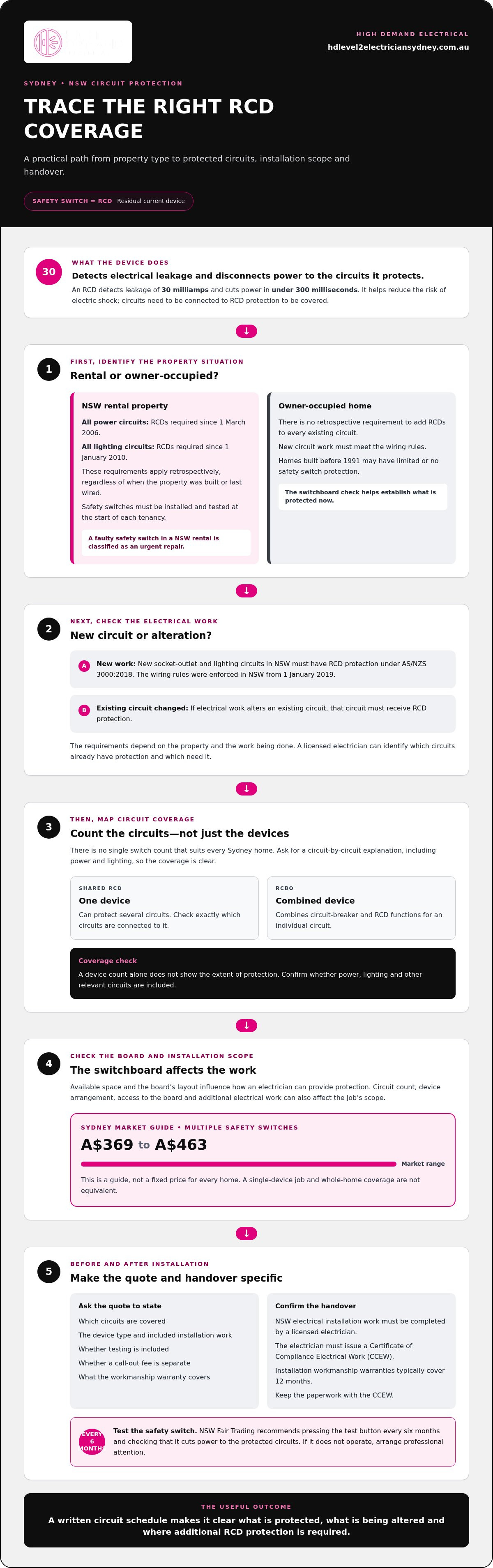
A safety switch, also called a residual current device (RCD), monitors electrical current for leakage. If it detects a fault, it disconnects power to the circuits it protects. An RCD detects leakage of 30 milliamps and cuts power in under 300 milliseconds. It helps reduce the risk of electric shock, but it doesn’t protect every circuit unless those circuits are connected to RCD protection.
New electrical work also affects what needs protection. Under AS/NZS 3000:2018, new socket-outlet and lighting circuits in NSW must have RCD protection. If electrical work changes an existing circuit, RCD protection is required for that circuit. The switchboard’s layout and available space influence how an electrician can provide that protection.
To see how circuit protection options differ, watch this explanation from eFIXX:
For a clear comparison, ask each quote to identify the circuits covered and the device type. A shared RCD can protect several circuits, while an RCBO combines circuit-breaker and RCD functions for an individual circuit. The number of devices alone doesn’t show the extent of protection. The quote should make clear whether power, lighting and other relevant circuits are included.
Does the safety switch installation price include parts, labour and testing? A quote may include the RCD and installation labour, but check that it also specifies testing and the circuits covered. Ask for these items in writing so you can compare equivalent work, rather than headline prices.
Compare warranty terms as well as inclusions. Safety-switch installation workmanship warranties typically cover 12 months. Have the quote state what the warranty covers, and keep the paperwork with the Certificate of Compliance Electrical Work (CCEW). NSW electrical installation work must be completed by a licensed electrician, who must issue a CCEW.
Do Sydney electricians charge call-out fees for installing a safety switch? Ask whether a call-out fee applies to the quoted job and whether it is separate from labour and materials.
Before work begins, confirm the electrician is licensed for the electrical work, then agree on the testing and handover steps. NSW Fair Trading recommends testing safety switches every six months. Press the test button and check that it cuts power to the protected circuits; arrange professional attention if it doesn’t operate. For electrical work involving network or supply-side infrastructure, a Level 2 electrician in Sydney handles that specialist scope.
NSW safety switch requirements
NSW requirements depend on whether a property is rented, owner-occupied or undergoing electrical work. For new circuits in owner-occupied homes, AS/NZS 3000:2018 requires RCD protection on new socket-outlet and lighting circuits. The wiring rules were enforced in NSW from 1 January 2019. When existing circuit work triggers an alteration, that circuit must also receive RCD protection.
There’s no single switch count that suits every Sydney home. The number depends on the circuits requiring protection and the switchboard arrangement. A licensed electrician can identify which circuits have RCD protection and which need it. Ask for a circuit-by-circuit explanation, including power and lighting, rather than relying only on the number of devices.
Rental rules are more specific. NSW rental properties have required RCDs on all power circuits since 1 March 2006, and on all lighting circuits since 1 January 2010. These obligations apply retrospectively, regardless of when the property was built or last wired. Safety switches must be installed and tested at the start of each tenancy under the Residential Tenancies Regulation 2019.
A faulty safety switch in an NSW rental property is classified as an urgent repair. Landlords should ensure required protection is installed before a new tenancy begins, then confirm operation at the start of the tenancy. NSW Fair Trading recommends testing safety switches every six months. A tenant or landlord can press the test button; if it doesn’t trip, arrange attention from a licensed electrician.
Owner-occupied homes don’t have a retrospective requirement to add RCDs to every existing circuit. However, new circuit work must meet AS/NZS 3000:2018, and altering an existing circuit triggers protection for that circuit. Homes built before 1991 may have limited or no safety switch protection, so checking the board helps establish current coverage.
Western Australia has separate rules, so don’t apply them to a Sydney property. Before title transfer, WA homes must have at least two RCDs protecting all power-point and lighting circuits. No more than three circuits may be protected by one RCD. WA landlords must have RCDs installed before a tenancy starts, and sellers must arrange required protection before title transfer.
Across Australia, the applicable wiring rules and state or territory requirements govern electrical safety. For a NSW property, distinguish rental obligations from requirements triggered by new work. A written circuit schedule helps clarify this: it can show which circuits are protected, which are being altered and where additional RCD protection is required.
Safety switch and RCD installation costs in Sydney
The cost to install safety switches in Sydney depends on the protection required and the condition of the switchboard. As a market guide, installing multiple safety switches typically costs between A$369 and A$463. This is a market range, not a fixed price for every home. Circuit count, device arrangement, access to the board and any additional electrical work affect the job’s scope.
A single-device job and whole-home coverage aren’t equivalent. One RCD may protect a group of circuits, while individual RCBOs can provide circuit-by-circuit protection. The number of circuits, how they’re grouped and the switchboard’s available space all influence the work. Ask the quote to specify which circuits receive protection, which devices are included and whether testing is part of the job.
Are there different costs for single-phase and three-phase safety switches? The phase configuration can affect the protection equipment and switchboard work required, but it doesn’t establish a standalone price. The circuit layout, device selection and any required board changes determine the installation scope.
Replacement is another distinct job. An existing RCD may need replacing if it fails testing or no longer operates correctly. Safety switches typically have a lifespan of 10 to 20 years, depending on usage and environmental conditions. Replacement cost depends on the device, labour, access and whether the board needs modifications, so compare the quoted scope rather than assuming every replacement is identical.
Switchboard condition can change the job substantially. A modern board with spare space may accommodate additional protection without a broader upgrade. Older boards may lack suitable capacity or room, making modification or a switchboard upgrade part of the work. If an upgrade is needed, the electrician must account for the board work as well as the RCD installation when setting out the quote.
For a useful comparison, request itemised quotes describing the same work. Check the number and type of devices, circuits covered, testing, any switchboard modifications and the applicable workmanship warranty. A lower figure may cover fewer circuits or exclude board changes, so compare inclusions before totals. NSW electrical work must be carried out by a licensed electrician, with a Certificate of Compliance Electrical Work issued for the work.
Compliance requirements also affect the scope. New circuits and altered existing circuits require RCD protection under the applicable NSW rules. That can make a small installation different from a project involving new circuit work or board alterations. Record the circuits covered and work completed in the electrical paperwork, so future testing or repairs can be assessed against the installation.
Prices for single and multiple RCD installations
A single residual current device (RCD) and a multi-device installation involve different scopes. One RCD can protect a group of circuits, while multiple devices can divide protection across more circuits. The market range for installing multiple safety switches is A$369 to A$463. Treat this as a market guide, not a fixed quote or a price for every switchboard.
What factors affect safety switch installation costs in Sydney? The number of circuits, RCD type, switchboard space, wiring condition and testing requirements shape the work. A compatible board with spare capacity may need less modification than an older board that requires changes. Ask for an itemised quote identifying devices, protected circuits, labour, testing and any board alterations.
Sydney suburb benchmarks can differ. Inner-city and eastern Sydney installation rates typically sit above western Sydney benchmarks. Market examples also place a two-switch installation in Blacktown below one in Bondi. These are location examples, not guaranteed prices for a particular property. Access, circuit layout and switchboard condition still affect the scope.
Regional NSW has its own price patterns. Newcastle installations typically cost less than Sydney equivalents, and Wollongong and the Illawarra generally cost less as well. These regional comparisons help explain why a Sydney estimate may not match a job elsewhere. Device count and wiring work remain important, even when the location changes.
Perth RCD prices are a separate comparison, not a Sydney quote. Perth has different local market benchmarks, and Western Australia has its own RCD requirements. For example, WA homes need at least two RCDs protecting power-point and lighting circuits before title transfer. Use NSW rules and Sydney pricing when assessing a Sydney property.
Appliances and circuit arrangement can also affect device selection. A residual current device responds to leakage current, while the required protection depends on the circuits and electrical equipment involved. If a device trips, note which circuits lose power and whether it resets. A faulty RCD or wiring issue may need investigation before replacement, so a simple device swap may not describe the full job.
Compare like with like. Check whether each quote covers the same circuits, number of devices, testing and compliance paperwork. A single-device quote cannot be compared directly with a multi-circuit installation. For a useful decision, request a circuit schedule showing where each RCD provides protection and identifying any excluded circuits.
Single RCD installation and circuit coverage
A single RCD can protect one circuit or a group of circuits, depending on the switchboard design. It monitors for current leakage and disconnects the protected circuit when it detects a fault. Check the board schedule to see which circuits connect to that device. If several circuits share one RCD, a fault on one can interrupt power to every circuit it protects.
An RCD and a standard circuit breaker perform different protective roles. An RCD responds to current leakage, while a circuit breaker protects against overloads and short circuits. An RCBO combines both functions for an individual circuit. This distinction matters when comparing a shared RCD arrangement with dedicated RCBOs: the devices differ in how they isolate faults and how much of the home loses power.
Coverage matters more than the number of switches alone. For example, one RCD may cover several power circuits but leave lighting circuits without protection. Ask for a circuit-by-circuit schedule showing the device, each connected circuit and any circuits outside its coverage. In NSW, new socket-outlet and lighting circuits require RCD protection under AS/NZS 3000:2018.
There isn't a single circuit limit that applies to every Sydney home. The switchboard design, RCD rating, wiring and connected load determine suitable circuit grouping. Appliance power requirements can help inform capacity, but an electrician must assess the circuit and protection needs. Western Australia's rule limiting one RCD to three circuits is a WA requirement, not a Sydney setting.
Testing helps confirm that an installed RCD operates. Use its test button according to the manufacturer's instructions, then check that power stops to the protected circuits. If it fails to trip or trips repeatedly during ordinary use, don't assume the device alone is faulty. A connected appliance, wiring fault or RCD problem may be involved; an electrician can test the installation and identify the cause.
Installation time and labour depend on board access and circuit arrangement. A single RCD on a modern switchboard with available capacity takes around 30-60 minutes, with the typical cost to install a safety switch in Sydney ranging from $150 to $300 per device depending on switchboard accessibility. Installing RCDs across all circuits on a modern board typically takes 1-2 hours. If the board needs modification, that work adds to the job, so ask the quote to separate device installation, testing and switchboard changes.
Expect a standard single RCD installation in Sydney to cost between $150 and $300 including labour and testing. Treat that price range as a guide to the stated scope, not a cost for broader circuit coverage. Before approving work, confirm which circuits will be protected and whether the quote includes testing and compliance documentation. Request an electrical quote for your switchboard with High Demand Electrical for the circuits you need assessed.
High Demand Electrical: Level 2 ASP Electrical Services
High Demand Electrical provides Level 2 ASP Electrical Services for electrical infrastructure work, and Switchboard Upgrades when an existing board needs renewal. If your safety-switch assessment identifies limited board capacity or broader supply-side work, these services may address the related electrical requirements. The right scope depends on the circuits and infrastructure involved.
For example, a switchboard upgrade may be relevant when the current board cannot accommodate required changes. Level 2 ASP services address specialised electrical infrastructure needs, rather than routine appliance repairs. Clear details about the board, circuits and planned electrical work help define the next step.
To discuss your electrical requirements, contact High Demand Electrical or visit hdlevel2electriciansydney.com.au.
Plan the next step with confidence
Before arranging electrical work, write down what you want resolved: a switchboard concern, a supply issue or a property infrastructure project. This gives the discussion a clear focus and helps connect the cost to install a safety switch in Sydney with the work your property needs, rather than treating price as a standalone figure.
High Demand Electrical offers Level 2 ASP Electrical Services, Switchboard Upgrades and Private Power Pole Installation. These services are relevant when your next step involves electrical infrastructure or a switchboard project. The price depends on the case and is provided after a quote request, with the work required and site conditions shaping the scope.
Share the relevant details about your property and the issue you’re addressing. Contact High Demand Electrical to discuss your electrical requirements, and take the next step with a clearer plan.
Frequently Asked Questions
Do RCDs protect hard-wired appliances like the oven and hot water?
Yes, if the appliance’s circuit has RCD protection. Hard-wired ovens and hot-water systems don’t receive protection simply because another circuit has a safety switch. For example, an oven circuit connected to an RCD or RCBO can be protected by that device. Ask the electrician to identify each appliance circuit on the switchboard schedule, then confirm whether it is covered or needs separate protection.
How long does it take to install RCDs?
A single RCD installation on a modern switchboard with available capacity takes around 30-60 minutes. A single installation may take 1-1.5 hours, depending on the board and work required. The electrician also needs to test the device and identify the circuits it protects. For a clear time estimate, describe the switchboard and whether you need one circuit or wider coverage assessed.
How much does it cost to install a safety switch in Sydney?
The cost to install a safety switch in Sydney varies with circuit coverage, switchboard capacity and any modifications needed. A quote should identify the included circuits and testing, so you can distinguish a single-circuit installation from broader protection.
What is the average cost to replace a safety switch in Sydney?
That figure is a market guide for replacement, not a quote for diagnosing a separate electrical fault. If a switch trips repeatedly, the cause may involve the device, wiring or connected equipment. Ask the quote to distinguish replacement from fault-finding or additional switchboard work, and confirm whether testing is included.
What Australian electrical standards apply to safety switch installation?
In NSW, AS/NZS 3000:2018, known as the Wiring Rules, applies to new circuit work and alterations. It requires RCD protection on new socket-outlet and lighting circuits. Requirements can vary by state and by the type of electrical work, so don’t apply another state’s rules to a Sydney property. Keep the Certificate of Compliance Electrical Work with your records after installation.
Can a safety switch be installed in an existing switchboard, or is a switchboard upgrade needed?
An existing switchboard can accommodate an RCD if its design and available space suit the required device. A board without suitable capacity may need modification or an upgrade before installation can be completed. The circuit arrangement and board condition guide that decision. Ask the proposed work to specify whether it covers RCD installation alone or includes switchboard changes.
How long does safety switch installation take, and what can make it more expensive?
Full RCD protection across all circuits on a modern switchboard typically takes 2-4 hours. Extra time may be needed if the board requires an upgrade, circuits need further work or testing identifies a fault. The number of circuits and access to the board also shape the job. Ask for a written scope separating installation, testing and any switchboard modifications.
How do I find a licensed electrician to install a safety switch in Sydney?
Choose a licensed electrician for NSW electrical installation work, and ask for a Certificate of Compliance Electrical Work after completion. High Demand Electrical states EC Licence 397193C and Level 2 Accredited Service Provider (ASP) accreditation. For a Sydney enquiry, call 0402 559 777 or email chris@highdemandelectrical.com.au. Share the switchboard details and the circuits you want assessed to help describe the required work.
Powering Your Needs with Expertise
If you’re looking for a reliable, experienced, and prompt electrician, look no further than High Demand Electrical. We cater to all your electrical needs, from routine maintenance to emergency repairs and complete system installations. Our skilled team is committed to providing professional service that ensures your electrical systems run smoothly. Whether it's a small task or a large project, give us a call today. Let us meet all your electrical demands with the quality and reliability you deserve.

