RCD safety switch testing in NSW: legal rules and intervals
A push-button check is not the same as an instrument test. In NSW, workplace RCDs must be tested regularly by a competent person, and the RCD safety switch testing requirements in NSW depend on workplace conditions and equipment risks. According to the NSW legislation register, workplace electrical safety is governed by the Work Health and Safety Act 2011 and the Work Health and Safety Regulation 2022.
If you’re responsible for a workplace, you may want one clear testing interval. In practice, the required frequency depends on the environment and how equipment is used, so a schedule that suits one site may not suit another.
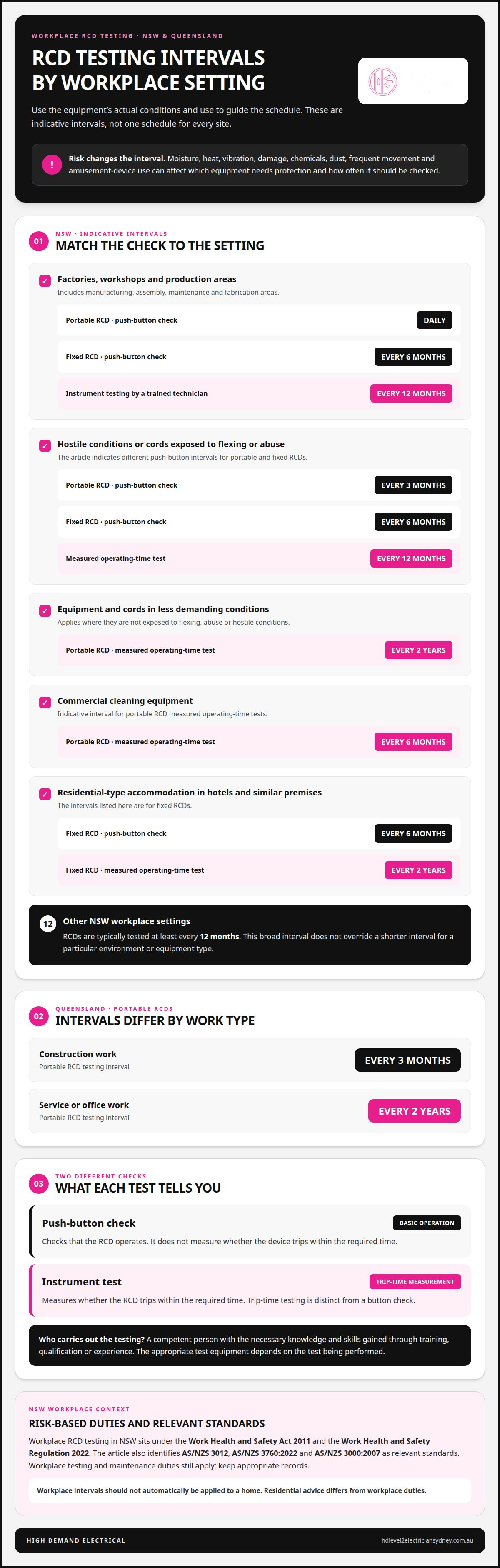
This article explains how NSW and Queensland rules differ, which workplace intervals are indicative, and what each type of RCD test can tell you. In Queensland, for example, portable RCDs used for construction work require testing every 3 months, while those used for service or office work require testing every 2 years.
A push-button check and an instrument test serve different purposes. Understanding the difference helps you set a clearer workplace testing schedule.
Key Takeaways
• In NSW, workplace RCD testing is governed by the Work Health and Safety Act 2011 and the Work Health and Safety Regulation 2022, according to the NSW legislation register.
• Workplace testing intervals depend on the environment and equipment use; higher-risk settings can require more frequent checks than ordinary workplaces.
• A push-button check confirms basic operation, while instrument testing measures whether an RCD trips within the required time.
• Queensland intervals differ by work type: portable RCDs used for construction work are tested every 3 months, compared with every 2 years for service or office work.
• When electrical infrastructure needs attention alongside safety planning, a switchboard upgrade may be a relevant next step.
What are the legal requirements in NSW & QLD?
In NSW, workplace RCD duties sit within work health and safety law. Testing requirements depend on the equipment, how it is used and the risks at the workplace. Queensland has different intervals for some portable RCDs.
Fault Detection and Shock Protection
A residual current device (RCD), also called a safety switch, detects an imbalance between current flowing through active and neutral conductors and disconnects power when leakage to earth occurs. This interruption helps reduce the risk of electric shock if current passes through a person or faulty equipment. Standard RCDs typically trip at a leakage current of 30 milliamps. A working device matters, but it does not remove the need to manage damaged equipment and electrical hazards.
Equipment Requiring RCD Protection
NSW workplace requirements apply to plug-in electrical equipment used, or potentially used, in higher-risk workplaces. This includes equipment exposed to moisture, heat, vibration, mechanical damage, corrosive chemicals or dust, as well as equipment moved frequently or in ways that could cause damage. Equipment used with an amusement device is also covered. These conditions help determine which equipment needs RCD protection and how often it should be inspected and tested.
For construction sites, workplaces and homes, the rules are not identical: NSW workplace testing follows work health and safety duties and risk-based intervals, while Queensland requires portable RCDs used for construction work to be tested every 3 months and those used for service or office work every 2 years. Residential advice differs from workplace duties, so a workplace interval should not automatically be applied to a home.
Inspection and Testing Obligations
Electrical equipment inspection and testing must be carried out by a competent person, meaning someone with the necessary knowledge and skills gained through training, qualification or experience. A push-button check tests basic operation; instrument testing measures whether the RCD trips within the required time. The appropriate test equipment depends on the test being performed, and trip-time testing is distinct from a button check.
In New South Wales, workplace RCD testing is governed by the Work Health and Safety Act 2011 and the Work Health and Safety Regulation 2022, according to the NSW legislation register. AS/NZS 3012, AS/NZS 3760:2022 and AS/NZS 3000:2007 are also identified as relevant standards for RCD and workplace electrical requirements.
NSW rental properties must have RCDs and smoke alarms tested and maintained. At the start of each new tenancy, the agent or landlord and tenant must indicate on the entry condition report whether the safety switch is working. A faulty switch during a tenancy is considered an urgent repair.
For new work, safety switches have been required on new power point circuits installed since 1991 and new light circuits installed since 2000. Older circuits are not legally required to have them, although NSW Fair Trading strongly recommends their use. The requirements for a renovation depend on the circuits being installed.
Failing to meet workplace testing and maintenance duties can create compliance risks and leave electrical hazards unmanaged. No NSW penalty amount is stated here, but workplaces must still arrange regular testing by a competent person and keep appropriate records.
Indicative testing intervals by workplace environment
In NSW, workplace RCD testing intervals depend on the environment, equipment and risk of damage. The RCD safety switch testing requirements NSW workplaces must follow reflect these risks, so one schedule may not suit every device. A portable RCD on a factory floor faces different conditions from equipment in an office.
Higher-risk workplaces include sites where equipment may be exposed to moisture, heat, vibration, mechanical damage, corrosive chemicals or dust. Frequent movement and use with amusement devices also affect the risk profile. These conditions influence which equipment needs RCD protection and how often it should be inspected and tested. Assess the equipment’s actual use and surroundings, rather than relying only on the workplace type.
Common indicative intervals differ by setting and test type:
Factories, workshops and manufacturing, assembly, maintenance or fabrication areas
users should push-button test portable RCDs daily and fixed RCDs every 6 months. A trained technician should conduct instrument testing every 12 months.
Hostile environments or cords exposed to flexing or abuse
the indicative push-button interval is 3 months for portable RCDs and 6 months for fixed RCDs. Measured operating-time testing is indicated every 12 months.
Equipment and cords not exposed to flexing, abuse or hostile conditions
the indicative interval for portable RCD measured operating-time tests is 2 years.
Commercial cleaning equipment
portable RCD measured operating-time tests are indicated every 6 months.
Residential-type accommodation areas in hotels and similar premises
fixed RCD push-button checks are indicated every 6 months, with measured operating-time tests every 2 years.
For other NSW workplace settings, RCDs are typically tested at least every 12 months. That broad interval does not override a shorter interval for a particular environment or equipment type. For example, commercial cleaning equipment has a 6-month measured-test interval, while portable RCDs in factories have daily button checks.
Keep the test methods distinct when setting a schedule. A button test checks basic operation, while an instrument test measures operating time. The device category and workplace exposure determine the applicable interval. If equipment moves from an office into a workshop, reassess the risks and schedule instead of carrying over the old interval. This ties the RCD safety switch testing requirements NSW sites manage to the equipment’s actual use.
For NSW electrical equipment testing records, include the tester’s name, test date, outcome and next test date. Keep records until the equipment is next tested, permanently removed from the workplace or disposed of. A tag attached to the equipment may serve as the record.
If an electrical infrastructure issue affects workplace safety, contact High Demand Electrical to discuss Level 2 ASP Electrical Services.
RCD push-button checks versus instrument testing
A push-button check and an instrument test answer different questions about an RCD. The button checks basic operation; an instrument test measures whether the device trips within the required time.
Push-Button Functional Checks
A push-button functional check uses the RCD’s test button to trigger its tripping mechanism. If the device trips, the check confirms that it responds to the test function. Trained staff can carry out routine button checks, making them practical for regular checks in workplaces and commercial settings.
A button test has one important limit: it does not measure trip time. The device may trip during a button check, but that result alone does not show how quickly it operates under an instrument test. Treat the results as different evidence, not interchangeable records of the same test.
For general-purpose RCDs, the button check also does not measure the current threshold at which the device trips. For a commonly applied test on a 30 mA RCD, the device should not trip at half rated sensitivity, or 15 mA. That measured result requires an instrument, not a push of the button.
Instrument-Based Trip-Time Testing
Instrument testing applies a measured test current and records the RCD’s operating time. It assesses performance under specified test conditions, rather than simply confirming that the button function causes a trip. A licensed electrician must complete trip-time testing.
For a general-purpose 30 mA RCD, a commonly applied test requires tripping within 300 ms at rated sensitivity. Where the test at five times rated sensitivity applies, the device must trip within 40 ms. These are separate test conditions, so one result cannot replace the other.
The distinction matters in practice. An RCD that trips during a button test has not thereby proved it meets a measured trip time. An instrument result describes performance under its test conditions, while routine button checks remain a separate functional check. When reviewing a commercial site’s test history, identify which method was used.
Record each outcome against the method used: label a button check as a push-button test and an instrument measurement as a trip-time test. If an RCD fails to trip during a button check or fails its measured test, it has not passed that check. A qualified electrician should repair or replace a failed device before it is relied on for protection.
What is a safety switch and why is it important?
For a general-purpose 30 mA residual current device (RCD), a commonly applied test requires no trip at half rated sensitivity, or 15 mA, and tripping within 300 ms at rated sensitivity. Where a test at five times rated sensitivity applies, the maximum trip time is 40 ms. These limits help confirm how the device responds under specified test conditions.
An RCD compares current flowing through the active and neutral conductors. If current leaks to earth, the imbalance can trigger the device to disconnect the supply. Standard RCDs typically trip at a leakage current of 30 milliamps. That protective function matters because electrical equipment can develop faults that expose a person to electric shock.
Trip-current and trip-time measurements describe different parts of RCD performance. Trip current is the level of residual current applied during a test; trip time is how long the device takes to disconnect the circuit. A result at 15 mA, for example, addresses the no-trip test for a general-purpose 30 mA RCD, not its operating time at rated sensitivity.
The applicable time limit also depends on the RCD type and test current. Under the AS/NZS 3760:2022 table, a Type I RCD has a maximum trip time of 40 ms when tested at 10 mA. A Type II RCD has a maximum trip time of 300 ms when tested at 30 mA. These are different test conditions, so the figures should not be treated as interchangeable limits.
For a general-purpose 30 mA RCD, the commonly applied rated-sensitivity test checks whether it trips within 300 ms. At five times rated sensitivity, where that test applies, the maximum is 40 ms. A test result needs to be read alongside its applied current and RCD type; a time without those details does not show which limit was assessed.
The distinction between current and time is important in Australian electrical safety because a device that trips may still need its operating time measured. Instrument testing supplies those measurements; a functional button check does not confirm trip time. SafeWork NSW published its Code of Practice for Managing Electrical Risks in the Workplace in September 2016, providing a workplace safety reference for managing electrical risks.
Test results should identify the device and test conditions clearly, including the applied current and measured operating time. For instance, recording a 30 mA test separately from a five-times-sensitivity test prevents the two results being confused. Trip-time testing should be handled by an appropriately qualified person, and a failed RCD should be assessed and repaired or replaced before it is relied on for protection.
RCD and safety switch testing
RCD testing checks the protective device, while test and tag focuses on electrical equipment connected to a circuit. NSW workplaces need both activities where applicable: testing a socket’s safety switch does not establish that a connected tool or extension lead is safe to use.
An RCD test checks whether a fixed or portable device operates as intended. Test and tag involves inspecting and testing appliances, tools and extension leads, then marking inspected items with tags. For example, a workshop may need its circuit RCD tested and its portable drill and lead inspected separately. These checks cover different parts of workplace electrical safety.
Intervals depend on the device and its use. Portable RCDs on hire equipment have an indicative measured operating-time testing interval of 3 months, and portable hire-equipment RCDs should be tested and tagged every 3 months. Hire equipment should also receive a push-button test from the hirer before hire. That pre-hire check does not replace the scheduled instrument test.
Construction work also affects the applicable schedule. In Queensland, portable RCDs used for construction work must be tested every 3 months. In NSW, workplace intervals depend on equipment and risk, including whether the work exposes a device or cord to damage, flexing or harsh conditions. A construction site should not assume that a portable RCD’s button test is its only required check.
Records help distinguish between checks. NSW electrical equipment testing records must identify the tester and include the test date, outcome and next test date. A tag attached to the item may serve as the record. Keep equipment testing records until the equipment is next tested, permanently removed from the workplace or disposed of.
For RCD tests other than push-button checks, NSW records must be kept until the device is next tested or disposed of. A useful record identifies the RCD and states whether the result came from a functional check or a measured test. This helps prevent a button-test entry from being mistaken for evidence of measured operating time.
If an RCD fails a test, a qualified electrician should repair or replace it. Keep the affected circuit or portable device out of service until the fault is addressed. A new inspection tag does not resolve a failed result. Clear records help responsible people identify the device, its test outcome and the follow-up required.
For support with electrical infrastructure affecting workplace safety, discuss your electrical safety requirements.
High Demand Electrical: Switchboard Upgrades
High Demand Electrical can help with switchboard upgrades and repairs when RCD testing identifies an issue that needs electrical work. A test measures device operation; it does not replace repairs or upgrades when the switchboard itself needs attention.
Consider a switchboard upgrade when the board’s condition or configuration needs work as part of addressing electrical safety. High Demand Electrical also provides Level 2 ASP Electrical Services for relevant electrical infrastructure needs. The right scope depends on the issue identified, so keep testing results distinct from any installation or upgrade work required.
Contact High Demand Electrical to discuss switchboard upgrade requirements.
Turn test findings into a clear next step
Make RCD maintenance part of a wider electrical safety plan, not an isolated task. Use test results to identify follow-up work, assign responsibility and keep relevant records with the equipment. If a result points to a problem beyond routine testing, address the underlying electrical issue rather than treating another button check as a fix.
Understanding RCD safety switch testing requirements in NSW helps you make informed decisions about workplace protection. Your next step should reflect the condition of your installation. If switchboard or other electrical infrastructure work is needed, High Demand Electrical can help identify a practical way forward through its electrical services.
For advice on the electrical work your test findings may require, contact High Demand Electrical. A clear plan helps you move from test results to considered action with confidence.
Frequently Asked Questions
What is RCD Testing?
RCD testing checks whether a residual current device responds to a test condition and disconnects its circuit. Depending on the method, testing can assess basic operation or measure trip current and operating time. A push-button check tests the device’s functional mechanism, while an instrument test measures its response. These results describe the RCD, not the condition of every appliance connected to the circuit.
What makes a test record another electrician can follow?
A useful record identifies the device and makes the result easy to understand later. Include its location or circuit reference, whether it is fixed or portable, the test method and the result. NSW electrical equipment testing records must include the tester’s name, test date, outcome and next test date. Distinguish an instrument test from a push-button check rather than recording both simply as “tested”.
What are the NSW legal requirements for RCD safety switches in workplaces?
NSW workplace RCD testing is governed by work health and safety legislation. The person managing the workplace must ensure that RCDs used at work are tested regularly by a competent person. Requirements apply to plug-in equipment used, or potentially used, in higher-risk settings. A workshop with equipment exposed to dust, moisture or mechanical damage should take those conditions into account when managing RCD protection and testing.
How often must RCDs be tested in NSW workplaces?
There is no single interval for every NSW workplace RCD; the schedule depends on the environment, equipment and test type. For example, in factories and workshops, users should push-button test portable RCDs daily and fixed RCDs every 6 months. A trained technician should test RCDs in these settings every 12 months. Equipment exposed to flexing, abuse or hostile conditions also affects the applicable interval.
What are the NSW RCD push-button test requirements and procedures?
A push-button check uses the device’s built-in test button to check whether it trips. In NSW factories, workshops and similar workplaces, users should test portable RCDs daily and fixed RCDs every 6 months. Routine push-button checks can be carried out by trained staff, but they do not measure trip time. If an RCD fails to trip, it should not be treated as having passed its check.
What are the AS/NZS 3760 requirements for RCD testing and records?
AS/NZS 3760 is identified as relevant to periodic RCD testing, including in NSW workplaces. The applicable testing interval depends on equipment and conditions, so a standard reference does not mean every device has the same schedule. In NSW, records of RCD tests other than push-button checks must be kept until the device is next tested or disposed of. Keep measured results distinct from functional checks.
Need Help Fast?
Powering Your Needs with Expertise
If you’re looking for a reliable, experienced, and prompt electrician, look no further than High Demand Electrical. We cater to all your electrical needs, from routine maintenance to emergency repairs and complete system installations. Our skilled team is committed to providing professional service that ensures your electrical systems run smoothly. Whether it's a small task or a large project, give us a call today. Let us meet all your electrical demands with the quality and reliability you deserve.

Licensed Level 2 ASP electricians across Sydney. Same-day service and 24/7 emergency response.
Licence 397193C
ABN 87 051 836 527
