Off-peak EV charging in Sydney: compare electricity plan costs
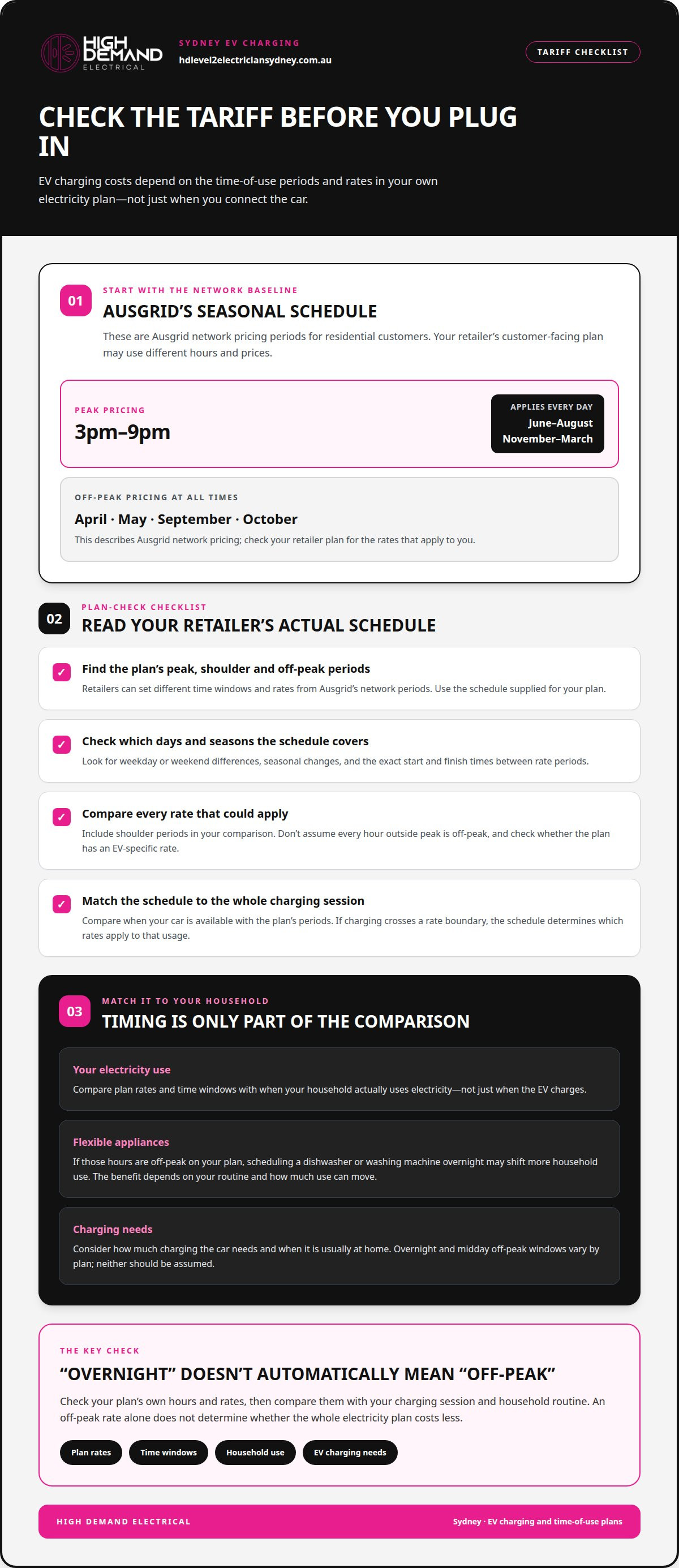
Off-peak EV charging solutions in Sydney depend on the time-of-use periods in your electricity plan, not just the time you plug in. Ausgrid network peak pricing applies from 3pm to 9pm every day during June to August and November to March; in April, May, September and October, off-peak pricing applies at all times. Retail plans can set different windows and rates.
Charging outside peak hours can help reduce the cost of running an EV, but an off-peak rate does not automatically make an electricity plan cheaper overall. The result depends on the plan’s rates and time windows, your household’s electricity use, and how much charging your car needs. This guide explains how Sydney time-of-use periods work, what to compare with a flat-rate plan, and when shifting charging may suit your household. You’ll be better placed to decide whether overnight charging, another off-peak period or a consistent flat rate fits your routine.
Key Takeaways
• On Ausgrid network pricing, peak periods run from 3pm to 9pm during June to August and November to March; in April, May, September and October, off-peak pricing applies all day.
• Your retailer’s time windows and rates may differ from Ausgrid’s network periods, so compare the details for your own plan.
• Weigh the off-peak rate against peak and shoulder rates, daily charges and your household’s overall electricity use.
• A flat-rate plan may be a better fit if you can’t shift much of your electricity use to cheaper periods.
• Charging overnight may help you use off-peak electricity, but whether it suits you depends on your plan and household routine.
Time-of-use pricing: what’s next?
Time-of-use plans make the timing of household electricity use part of the cost comparison. For Sydney EV owners, the relevant periods depend on both the retail plan and the network tariff.
Time-of-use electricity tariffs
A time-of-use tariff charges different rates at different times, reflecting changes in electricity demand. That matters when an EV can charge outside expensive periods, but the network’s windows aren’t necessarily the retail plan’s windows. Ausgrid combined its off-peak and shoulder charging windows in 2024. New smart meter installations are increasingly assigned time-of-use tariffs, which can make timing a household decision.
Which Sydney electricity retailers offer EV-specific or time-of-use tariffs? Retailers set their own plans, so their rates and time windows can differ from Ausgrid’s network periods. Ausgrid’s network pricing outlines network time periods, not a list of retail offers. Compare the current plan’s peak, shoulder and off-peak periods, and check whether it includes an EV-specific rate.
For residential customers on Ausgrid network prices, peak pricing applies from 3pm to 9pm every day during June to August and November to March. Outside those months, peak periods don’t apply and off-peak pricing applies at all times. These are network pricing periods; a retailer’s customer-facing tariff may use different hours and prices.
Shifting household electricity use
Shifting household electricity use means running flexible appliances when your plan charges less. For example, you might schedule the dishwasher or washing machine overnight alongside EV charging, if those hours are off-peak on your plan. The benefit depends on your household’s routine: shifting one appliance may have little effect if most electricity use still falls in peak periods.
For an EV owner, charging is one part of a wider timing decision. An overnight charging schedule may fit a plan’s off-peak window, while daytime household use could fall under a different rate. Compare the plan’s rates with when your car and household actually use electricity. Don’t assume that one plan’s overnight window applies to another.
Reducing pressure on the electricity grid
Spreading EV charging beyond peak demand can help avoid sharp surges in electricity use and support grid stability. If many vehicles charge at once during a busy period, they add to demand. Distributing charging across lower-demand periods can reduce that concentration. Time-of-use pricing encourages households to consider charging times as well as the direct cost on their bill.
What electrical and strata rules apply to installing an EV charger in Sydney? Electrical requirements relate to the property’s supply and charger installation; strata requirements concern the building and its approval process. They are separate considerations, so installation planning needs to account for both. Level 2 electrical work in Sydney can address the electrical side of a charger project.
Start by comparing your plan’s time periods with your charging and appliance routines. A tariff can encourage you to shift usage, but its value depends on the hours available and how much electricity use can move. Aligning charging with off-peak windows can spread demand more evenly, while keeping your household’s total electricity use in view.
Checking plan-specific time windows
Electricity plans can have different peak, shoulder and off-peak periods. Check the exact schedule on your plan before changing charging times or choosing a different tariff.
Plan-specific charging windows
Plan-specific charging windows are the hours your retailer assigns to each electricity rate. They matter because an off-peak period on one plan may be a peak or shoulder period on another. Read the plan’s time-of-use schedule alongside its rates, including any weekday, weekend or seasonal differences. Use that schedule, not an assumed overnight window, to work out when charging costs less.
Retailers can set customer prices and periods that differ from Ausgrid’s network periods and charges. Treat them as separate schedules: the network period describes one part of electricity pricing, while your retail plan sets the rates charged to you. Ausgrid’s network windows can help explain the broader structure, but they do not replace your plan details. If your plan includes shoulder periods, include them in the comparison rather than treating every hour outside peak as off-peak.
Before changing an EV’s charging time, identify which days and seasons the plan’s schedule covers. For example, it may separate weekdays from weekends or change between seasons. These distinctions affect whether a charger starting at the same time each day lands in a cheaper period. Check the stated start and finish times, including the boundaries between periods, to see which rate applies during a charging session.
Off-peak hours for Sydney EV charging
Off-peak hours are the periods when a particular electricity plan applies its off-peak rate. In Sydney, these are commonly overnight and may include midday on some plans. The exact window matters: plugging in overnight does not necessarily mean the car charges entirely at the off-peak rate. Check whether charging overlaps another rate period.
Compare the plan’s schedule with your likely charging routine, not just the time you plug in. If charging begins before an off-peak window and continues into it, the plan’s periods determine which rates apply to that usage. A midday off-peak window may matter if your car is home during the day. These examples show why an assumed “cheap” time cannot replace checking the plan’s actual schedule.
For a fair comparison, use the same household routine across the plans you’re considering. Note when the EV is usually available, then compare those hours with each plan’s peak, shoulder and off-peak periods. Include household electricity use too, since a cheaper charging window may not offset higher rates during other periods. If the electrical setup is part of your charging decision, discuss a home EV charger installation.
Comparing time-of-use and flat-rate plans
A time-of-use plan can suit households that can shift flexible electricity use into lower-priced periods. A flat-rate plan can be simpler when household routines leave little room to change consumption times.
How do Sydney EV charging costs compare for home, public and workplace charging? Home charging is billed through your household electricity plan, so the total depends on its rates and when charging occurs. Public and workplace charging have their own pricing arrangements. Compare the actual charges and access conditions rather than assuming one option is always cheaper.
For a useful plan comparison, look beyond the headline off-peak rate. Include peak and shoulder rates, any daily supply charge, and how much household electricity falls into each period. A low overnight rate may suit an EV that charges then, but higher daytime rates can matter if cooking, cooling or other regular electricity use falls in peak periods.
A flat-rate plan may suit a household that cannot easily change when it uses electricity. The rate stays consistent throughout the day, so bills are less dependent on whether the EV or appliances run during peak, shoulder or off-peak periods. This can be useful for shift workers, households that need to charge during the day, or residents who cannot control when shared equipment operates.
Time-of-use pricing can suit a different routine. If your EV is usually at home during a plan’s cheaper period, charging can align with that rate. Consider your other electricity use too: shifting the car’s charging alone may not make the overall plan cheaper if substantial consumption remains in higher-priced periods. Compare your combined usage pattern, not one appliance in isolation.
Home, public and workplace charging also serve different needs. Home charging uses your household’s electricity plan, while a public charging session is priced under the charging site’s terms. Workplace arrangements may have separate access or payment conditions. When comparing these options, record the applicable charge for each session and how often each option is realistically available. An occasional public charging session may have less influence on total charging costs than a regular home routine.
Use a representative household pattern to compare plans, including usual EV charging, cooking, laundry and other significant electricity use. Then consider whether those activities can shift without disrupting daily life. A flat rate offers consistent pricing across usage times; with a time-of-use plan, timing matters more. The better fit depends on your household’s actual pattern, not the tariff label alone.
Off-peak EV charging
Charging at home during a plan’s off-peak period can reduce the rate applied to that electricity use. The practical setup depends on your tariff, vehicle, charger and property. For off-peak EV charging solutions Sydney households can use, the key is matching the charging schedule to the home’s electrical setup and plan.
Home charging costs off-peak
Off-peak home charging costs depend on the electricity used and the rate that applies during charging. To estimate the usage charge, multiply the kilowatt-hours used by the plan’s off-peak rate, then consider the rest of the household bill separately. How much does home charging cost off-peak in Sydney? It depends on those plan-specific inputs, not one city-wide price.
Which Sydney public charging networks offer cheaper overnight or off-peak rates? Public charging prices depend on the operator, site and applicable charging terms. There is no single off-peak rate across Sydney. Compare the price for a specific charging session with your home plan’s off-peak rate, while considering how often each option suits your routine.
Scheduled charging tools and setup
Scheduled charging tools let you set charging to begin during selected hours. Some EVs and home chargers have scheduling controls, while your electricity plan determines whether those hours are off-peak. What smart EV chargers can schedule charging in Australia? Look for a charger with scheduling controls that can match your plan’s stated window. You do not need a particular model to apply this approach.
To schedule off-peak charging in Sydney, find your plan’s off-peak start and finish times, then set the vehicle or charger schedule to match. If both offer scheduling, avoid conflicting settings that could prevent charging from starting as intended. Review the schedule if your plan’s time periods change, so charging continues to align with the applicable rate. These are practical off-peak EV charging solutions Sydney drivers can assess against their plan and routine.
Apartment off-peak charging options
Apartment off-peak options include charging at an allocated parking space, using shared building charging or relying on public chargers. Availability depends on the building’s electrical setup, parking arrangements and strata approval. These factors determine whether you can charge at home during a cheaper period or need to plan around another location.
What rebates or incentives are available for home EV chargers in NSW? Incentives depend on current program terms and eligibility. Include a rebate in your decision only if the relevant conditions apply to your property and installation. An advertised incentive does not automatically reduce the cost of a home charger.
Charging from a standard power outlet overnight can place a sustained load on the outlet and circuit. Poor condition, unsuitable wiring or an overloaded circuit can increase the risk of overheating. A suitable charging setup should account for the existing electrical supply rather than assuming any household outlet is appropriate for repeated EV charging.
What are off-peak electricity hours for EV charging in Sydney?
There is no single off-peak schedule for every Sydney household. The applicable hours depend on whether you are looking at Ausgrid network prices or your retailer’s electricity plan.
For residential customers on Ausgrid network prices, peak pricing applies from 3pm to 9pm every day during June to August and November to March. Outside those seasonal windows, peak periods don’t apply. In April, May, September and October, off-peak pricing applies at all times under Ausgrid’s network prices.
In summer and winter, Ausgrid off-peak periods apply outside the peak window. This gives EV owners a broad indication of when network pricing is off-peak, but it does not guarantee that the same period or rate appears on a retail bill. Retailers may set different hours and prices, so use your plan’s schedule to decide when to charge.
Off-peak periods are commonly overnight, and some Australian plans include a midday off-peak window. This difference matters if your EV is parked at home during the day rather than overnight. A midday period could suit a vehicle available then, while a night window may fit an evening return and overnight parking routine.
Use the plan’s exact start and finish times to understand how a charging session is billed. If a session crosses from off-peak into another rate period, the applicable rate can change during that session. The plan’s schedule, not just the time you plug in, determines which periods overlap with charging.
Compare the schedule with the days and seasons it covers. Ausgrid’s residential peak window applies every day in its listed seasons, while the network has no peak periods in April, May, September or October. A retailer’s plan may use different periods, so do not assume those seasonal network dates define your retail rates.
For a practical comparison, note when your EV is usually parked, then match those hours to the plan’s off-peak window. Include any midday period and seasonal changes shown in the schedule. If the car is away overnight, a night rate may offer little benefit. A home charging setup is most useful when its available charging hours align with the tariff.
If your home setup needs to suit a particular charging schedule, discuss a home EV charger installation.
Shifting charging away from peak hours can help reduce strain on South Australia’s electricity grid and the need for costly infrastructure upgrades. Peak hours have the highest electricity demand and place significant strain on the grid, while wind and solar availability can fluctuate and may not align with peak demand. Peak electricity rates are typically the most expensive and occur in the late afternoon and early evening. Australian households on time-of-use tariffs can charge after midnight as an off-peak strategy, and customers with certain meter types can choose a time-of-use tariff or pricing plan.
High Demand Electrical
High Demand Electrical installs Tesla and home EV chargers for Sydney households. If you are planning to charge at home, the installation can be considered alongside your property’s electrical supply and charging routine.
If the existing supply or switchboard needs attention as part of the project, High Demand Electrical also provides Level 2 ASP Electrical Services and switchboard upgrades. The right next step depends on your property, charger location and charging needs, not just the off-peak hours on your electricity plan.
Contact High Demand Electrical to discuss your home EV charging installation.
Make your next charging decision practical
Your next step is to connect your electricity plan with the way your home can support EV charging. Consider charger placement, the property’s electrical supply and how the setup will fit your routine. A clear picture of these factors can help you make a more informed decision about off-peak EV charging solutions in Sydney.
High Demand Electrical provides Level 2 ASP Electrical Services, switchboard upgrades and private power pole installation. These services address electrical infrastructure needs that may be relevant to a home charging project, alongside Tesla and home EV charger installation.
Contact High Demand Electrical to discuss your charging setup and the electrical work that may support it. A considered plan can help you move towards home charging with confidence.
Frequently Asked Questions
What does time-of-use pricing look like in practice?
Your electricity use is charged at the rate that applies when it occurs. For example, an EV charging overnight may use one rate, while cooking during an evening peak may use another. The bill groups usage by the plan’s time periods, so the overall result reflects both how much electricity you use and when. Compare those charges alongside any daily supply charge.
Which Sydney electricity retailers offer EV-specific or time-of-use tariffs?
Retailers set their own plans, and their time windows and rates may differ from Ausgrid’s network periods. Compare current plans for peak, shoulder and off-peak hours, and check for any EV-specific rate.
Need Help Fast?
Powering Your Needs with Expertise
If you’re looking for a reliable, experienced, and prompt electrician, look no further than High Demand Electrical. We cater to all your electrical needs, from routine maintenance to emergency repairs and complete system installations. Our skilled team is committed to providing professional service that ensures your electrical systems run smoothly. Whether it's a small task or a large project, give us a call today. Let us meet all your electrical demands with the quality and reliability you deserve.

Licensed Level 2 ASP electricians across Sydney. Same-day service and 24/7 emergency response.
Licence 397193C
ABN 87 051 836 527