
Leaning Power Pole: Who Should Arrange Inspection and Repairs
If your power pole is leaning and you’re wondering what to do, keep well clear and treat every power line as live. Stay at least eight metres from a fallen line, a low-hanging line or anything touching wires, and report an immediate hazard to the electricity network operator. Arrange an inspection of a privately owned pole by a qualified electrical professional.
A leaning pole can be worrying, and repair costs depend on what an inspection finds and what work is needed. This guide explains who arranges an inspection, what can affect repair costs, how to respond to cable hazards and which signs of deterioration need prompt attention.
Key Takeaways
• Learn how to recognise urgent cable hazards and what to do to keep people clear of danger.
• Understand why the owner of a private pole is generally responsible for arranging inspection and maintenance.
• See how pole condition, the extent of damage and the work required can affect repair costs.
• Find out why a qualified Level 2 ASP is suited to private electrical infrastructure work.
• Know which signs of deterioration to report and when to contact the electricity network operator.
Responding to low-hanging, damaged or grounded cables
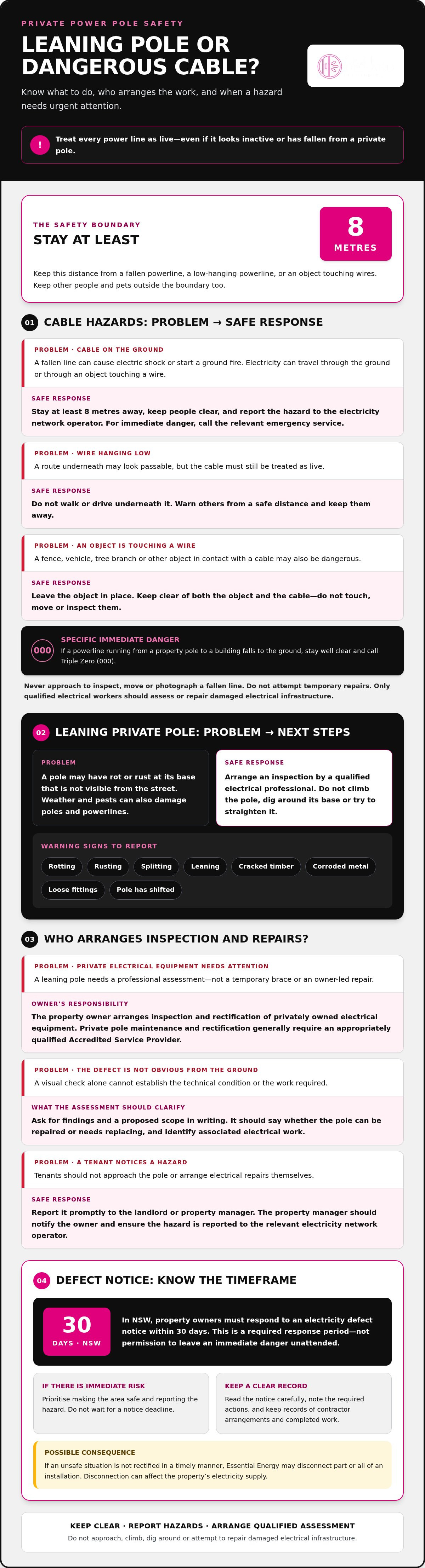
Keep clear of any cable that is hanging low, damaged or lying on the ground. Treat every power line as live, even if it looks inactive or has fallen from a private pole. Electricity can travel through the ground or through an object touching a wire. A fallen line can cause electric shock or start a ground fire, so do not approach to inspect, move or photograph it.
In Australia, stay at least eight metres from a fallen powerline, a low-hanging powerline or an object touching wires. Keep other people and pets outside that distance too. Do not touch a fence, vehicle, tree branch or other object that may be in contact with a cable. If a wire falls across a driveway or access path, warn others from a safe distance and keep them away.
If a cable is on the ground
stay at least eight metres away and keep people clear.
If a wire is hanging low
do not walk or drive underneath it, even if the route appears passable.
If an object touches a wire
leave it in place and keep clear of both the object and cable.
If a pole or cable has fallen
report the hazard to the electricity network operator; do not attempt temporary repairs.
For an immediate danger, call the relevant emergency service. As a general rule across Australia, including regions regulated under specific state frameworks such as in Queensland, if a powerline running from a property pole to a building falls to the ground, stay well clear and call Triple Zero (000). Do not assume a cable is safe because the supply appears to be off. Only qualified electrical workers should assess or repair damaged electrical infrastructure.
Private poles and powerlines can suffer structural damage from weather and pests. A failure can expose people to electric shock or fire, so the property owner must arrange inspection and maintenance of privately owned network components. A qualified, licensed professional from High Demand Electrical can assess damage that may not be obvious from the ground. Do not climb the pole, dig around its base or try to straighten it.
Property owners—such as landowners in Queensland who are responsible under the Electrical Safety Act 2002 and Electrical Safety Regulation 2013, as well as owners in New South Wales—must regularly inspect and maintain privately owned electricity infrastructure. A tenant who notices a leaning pole, damaged cable or exposed wire should report it promptly to the landlord or property manager. The property manager should notify the owner and ensure the hazard is reported to the relevant electricity network operator. Tenants should not approach the pole or arrange electrical repairs themselves.
Arranging repairs through a certified contractor
A leaning private power pole needs a professional assessment, not a temporary brace or an owner-led repair. The property owner is responsible for arranging inspection and rectification of privately owned electrical equipment.
Choosing a qualified repair contractor
A qualified contractor can inspect the pole, identify defects and determine what electrical work is needed to make the installation safe. Private pole maintenance and rectification are contestable work, so owners generally need an appropriately qualified Accredited Service Provider. The assessment should distinguish damage to the pole from issues with cables or connected equipment. This helps define the repair scope and identify who must coordinate any network-related work.
Ask for the inspection findings and proposed work in writing. The scope should explain whether the pole can be repaired or needs replacing, and identify any associated electrical work. This gives the owner a clear basis for arranging access, managing the work and keeping a record of the defect. Don’t attempt repairs yourself or treat a visual check from the ground as a technical assessment.
Repair response and completion timeframes
Response time depends on the hazard and any defect notice issued by the electricity network. In NSW, property owners must respond to an electricity defect notice within 30 days. Treat that as a required response period, not permission to leave an immediate danger unattended. Report urgent hazards promptly and organise the inspection and rectification needed to address the defect.
Read the notice carefully, note the required actions and keep records of contractor arrangements and completed work. If the pole or wiring presents an immediate risk, prioritise making the area safe and reporting the hazard rather than waiting for the notice deadline. The contractor’s findings, repair scope and access to the affected equipment all shape how the work proceeds.
Leaving defects unresolved can have practical consequences. Essential Energy may disconnect part or all of an installation if it detects an unsafe situation that isn’t rectified in a timely manner. Disconnection can affect the property’s electricity supply, while a deteriorating pole or damaged wiring may remain a safety hazard. Take defect notices seriously and keep the network informed as required.
For repair budgeting, the main factors are the pole’s condition, whether replacement is needed and what electrical work is associated with the defect. Request a written scope so you understand the proposed work before it begins. In some cases, Essential Energy may carry out private-pole work at the customer’s expense if local service providers aren’t available or a repair request hasn’t been met. This is not a general grant or subsidy; confirm the arrangement stated in any notice.
Property pole deterioration and hazards
A leaning power pole may have damage below ground that isn’t visible from the street. Rot or rust at the base can weaken its support, while weather and pests can damage private poles and powerlines. A pole that looks stable above ground may still need a qualified inspection if it has shifted, split or developed decay.
Look for visible warning signs without touching or climbing the pole. Ausgrid identifies rotting, rusting, splitting and leaning as defects that may be notified for safety reasons. Cracked timber, corroded metal, loose fittings or a pole that has moved from its previous position are reasons to arrange an assessment. Don’t dig around the base to investigate, as buried electrical equipment may be nearby.
Age can help prompt an inspection, but it doesn’t establish whether a pole is safe. Australian Standards indicate hardwood power poles can have a life expectancy of up to 40 years above ground and up to 25 years below ground. These figures describe potential service life, not a guarantee of condition. Ground moisture, damage, installation and maintenance can all affect structural integrity.
Arrange a professional inspection if you notice deterioration, after major storms or when the pole’s stability changes. Essential Energy recommends inspection after major storms and when owners suspect damage to a private pole or associated assets. It asks owners to arrange regular inspections annually before each bushfire season. Inspections can identify faults a ground-level visual check may miss.
Vegetation can create hazards around overhead electricity lines. Branches touching or close to wires can create a dangerous contact point, particularly during strong winds or storms. Don’t prune vegetation near powerlines yourself. In Tasmania, vegetation management near powerlines should be done only by an authorised contractor who can work close to them. In Western Australia, trees and branches should remain at least two metres from power lines.
Property owners are responsible for inspecting and maintaining privately owned electrical infrastructure. Western Power has a duty of care to inspect the first privately owned pole when it directly supports Western Power supply cables, but owners remain responsible for inspecting, maintaining and replacing it. In Western Australia, the network operator inspects only that first private pole connected to its overhead service cable. Owners remain responsible for other private poles on the property.
Keep the pole’s location, visible defects and inspection history ready for the qualified professional. If it leans further, a cable becomes damaged or a branch contacts a wire, treat the situation as urgent. Don’t assume an underground section is sound because the exposed part looks intact. Deterioration below ground can undermine the pole’s support and lead to failure.
Finding an authorised ASP/2 contractor
Private power pole work involves electrical assets connecting a property to the electricity network. Owners generally need an appropriately qualified Accredited Service Provider (ASP) for private pole maintenance and rectification. The Australian Energy Regulator’s Ring-Fencing Guidelines classify this maintenance and rectification as contestable work. This means owners arrange the work through a suitable service provider, rather than assuming the network operator will repair every pole.
Start by describing the defect clearly, for example, a pole leaning towards a driveway, visible rot near ground level or damaged overhead wires. Give the contractor the property address, the pole’s location and any defect notice details. This information helps identify which assets need inspection and whether the work concerns the pole, the overhead connection or related electrical equipment. Don’t approach a hazardous pole to gather details.
Before arranging work, establish that the provider is appropriately qualified for the specific private electrical work required. “ASP” refers to an Accredited Service Provider, but the label alone doesn’t describe every task a provider can perform. Explain whether the job involves inspection, repair or replacement, and ask for a written scope identifying the proposed work. A licensed electrical contractor may also be needed for electrical tasks connected with the pole.
Clarify how the work relates to the network connection. Private poles and network-owned assets may meet at a connection point, and responsibility depends on which equipment is privately owned. If a defect notice identifies the affected asset or required rectification, share it with the contractor. If ownership or network requirements affect the work, contact the relevant electricity network operator for direction about its assets.
Describe the issue
note whether the pole leans, has visible deterioration, or supports damaged overhead wires.
Share relevant records
provide any inspection findings or defect notice to the contractor.
Define the work
request a written scope covering the pole and associated electrical assets.
Separate urgent hazards
report immediate danger to the network operator, rather than waiting for routine repair arrangements.
In some cases, Essential Energy may carry out private-pole work at the customer’s expense if local service providers aren’t available or the customer hasn’t complied with a repair request. This is a specific circumstance, not a general way to arrange repairs. For a Sydney property, identify the relevant network operator and establish whether the affected equipment is private or network-owned. A clear description of the pole, connection and defect helps the appropriate provider assess the work required.
Reporting a leaning pole
If you’re asking, “my power pole is leaning, what do I do?”, report the condition to the relevant electricity network operator and arrange an inspection if it’s privately owned. If you can’t tell who owns the pole, describe its location and what it supports when reporting the hazard.
You can’t always identify ownership by appearance alone. An electricity pole may form part of the distribution network, while a private pole supports a property’s electricity connection beyond the network connection point. A telecommunications pole carries communications equipment. Don’t approach the pole to inspect labels or cables; report the uncertainty to the relevant network operator.
For immediate safety hazards involving electricity network equipment or privately owned poles and powerlines, contact Essential Energy on 132080. In Sydney, report the issue to the electricity network operator responsible for the property. Give the street address, nearest cross-street, pole location and a clear description, such as “leaning towards the driveway” or “overhead powerlines appear damaged”.
Share what you can observe safely. State whether the pole is leaning, split, rotting or rusting, and whether cables are hanging low or touching a tree. Don’t touch the pole, wires or anything in contact with them. If the pole’s condition changes or a cable falls, update the operator with the new hazard information.
Responsibility can depend on which assets the pole supports. The network operator can help establish whether the pole is part of its supply network or a private pole serving the property. The property owner arranges inspection and maintenance of privately owned electrical infrastructure. A tenant should promptly report a leaning pole to the landlord or property manager, who can notify the owner and organise the appropriate response.
In NSW, Ausgrid identifies rotting, rusting, split or leaning private poles as defects that may be notified for safety reasons. If you receive an electricity defect notice, read the stated requirements and arrange the specified response. NSW property owners must respond to an electricity defect notice within 30 days. Keep the notice and records of inspection or repair arrangements together.
Report the location, not a guess about the repair. For example, say a private pole appears to lean and supports overhead powerlines supplying a house. Don’t climb it, dig around its base or attempt to straighten it. If ownership is unclear, ask the network operator to identify the relevant asset and reporting channel.
For a suspected private pole, notify the property owner or manager and arrange an assessment by a qualified electrical professional. For network equipment, report the hazard to the responsible network operator. Clear reporting helps direct the issue to the party responsible for the pole and its electricity supply.
High Demand Electrical: Level 2 ASP Electrical Services
High Demand Electrical provides Level 2 ASP Electrical Services for electrical infrastructure work. If an inspection finds a private pole needs replacing, its Private Power Pole Installation service may suit the next stage. The assessment helps establish whether replacement is needed and what connected work the property requires.
For a leaning pole, first keep clear of any immediate hazard and arrange a qualified assessment. Once the required work is clear, contact High Demand Electrical to discuss private power pole installation or relevant Level 2 ASP electrical work. The team also handles consumer mains and overhead supply work where these form part of the project.
To discuss the next step for your property, contact High Demand Electrical.
Move from concern to a clear next step
If your power pole is leaning and you’re asking what to do next, focus on defining the work required. An assessment can clarify whether the pole needs attention and how its condition relates to the property’s electrical connection. This helps you plan repairs rather than making assumptions about the cause or extent of the problem.
High Demand Electrical provides Level 2 ASP Electrical Services, including Private Power Pole Installation. Its Switchboard Upgrades may also be relevant if switchboard work is part of your wider electrical project. Keep the inspection findings and any defect notice handy when discussing what the property needs.
Contact High Demand Electrical to discuss your power pole requirements and take the next step with a clearer plan.
Frequently Asked Questions
How much will it cost to fix defects?
Repair costs depend on the defect and the work needed to make the installation safe. A contractor considers the pole’s condition, whether replacement is necessary, damage to connected cables and any related electrical work. Ask for an inspection and a written scope before work begins. The price depends on the circumstances and is provided after a quote request; the inspection findings and repair requirements shape the quote.
If you have a private pole, what are your responsibilities?
If you own a private pole, you’re responsible for arranging its inspection, maintenance and necessary repairs. This responsibility includes privately owned poles, powerlines and associated electrical equipment on your property. For example, if a pole supports the overhead supply to your home, report visible changes and arrange an assessment by a qualified professional. If you’re a tenant, promptly tell your landlord or property manager rather than attempting electrical work yourself.
What should I do immediately if a power pole is leaning near my home in Australia?
Keep people away from the pole and any wires, then report the hazard to the electricity network operator. If you’re asking what to do when your power pole is leaning, don’t touch it, try to straighten it or inspect its base. Note the address and describe what you can see from a safe position. If a cable has fallen or someone faces immediate danger, call emergency services.
How do I report a leaning electricity pole to my local electricity distributor in Australia?
Contact the distributor responsible for your address and provide the street location, nearest cross-street and a clear description of the problem. Say whether the pole is leaning, split or supporting low-hanging or damaged wires. Your electricity bill identifies the distributor for your supply. In Sydney, contact the network operator responsible for your property, as it can help identify whether the pole is its asset or privately owned.
Who owns and is responsible for repairing a leaning power pole in Australia?
Ownership depends on the pole’s position and role in the electricity connection. Network operators own and maintain their network assets, while property owners are responsible for privately owned poles and associated equipment. A private pole commonly carries the supply onwards across a property. If ownership isn’t clear, report the location and ask the electricity distributor to identify the asset. The owner of a private pole arranges its inspection and repairs.
What phone number should I call to report a dangerous power pole in my Australian state or territory?
For immediate hazards involving Essential Energy’s network or privately owned poles and powerlines, call 132080. In other areas, contact the electricity distributor responsible for the property; the distributor’s details appear on the electricity bill. There isn’t one distributor number for every Australian state and territory. If there’s immediate danger to life, or a fallen line creates an emergency, call Triple zero (000).
When should I call 000 for a leaning power pole or fallen power lines?
Call Triple zero (000) when a fallen powerline creates an immediate danger, such as a wire on the ground near people or a building. In Queensland, a powerline fallen between a property pole and building should be reported to 000, while people stay well clear. Don’t wait for an ordinary maintenance appointment if someone is at risk. Keep others away and tell emergency services the precise location.
How far should I stay away from a leaning pole and any fallen power lines?
Stay at least eight metres from a fallen powerline, a low-hanging powerline or an object touching wires. Keep clear of a leaning pole too, particularly if it appears unstable or its cables are damaged. Don’t walk beneath hanging wires or approach to check the pole’s label. Warn others from a safe position, then report the hazard so the electricity network or pole owner can arrange an assessment.
Powering Your Needs with Expertise
If you’re looking for a reliable, experienced, and prompt electrician, look no further than High Demand Electrical. We cater to all your electrical needs, from routine maintenance to emergency repairs and complete system installations. Our skilled team is committed to providing professional service that ensures your electrical systems run smoothly. Whether it's a small task or a large project, give us a call today. Let us meet all your electrical demands with the quality and reliability you deserve.

