Cheap Level 2 electrical work: understand fees and added costs
A low headline quote doesn’t always mean a lower final bill. The hidden costs of cheap Level 2 electrical work can sit in items excluded from the quoted scope, such as call-out and travel fees, extra labour, materials, network coordination or after-hours attendance. The total depends on what the job requires and what the quote includes.
It’s sensible to compare quotes, but a low total can be hard to assess when the work and possible extras aren’t itemised. Compliance documents and changes required by existing infrastructure can also affect the final cost.
This guide explains how labour rates, call-out fees, quote exclusions, compliance certificates and after-hours premiums influence Level 2 electrical work costs in Sydney. You’ll also learn which site and job factors can change the scope, so you can better understand what a quote covers before work begins.
Key Takeaways
• Assess the full call-out charge, including what it covers and whether travel or urgent attendance adds to the labour cost.
• Compare quotes by scope, not just the final total, and look for possible exclusions such as network coordination or existing infrastructure upgrades.
• Compliance documentation is part of understanding the work completed, not an optional extra to overlook when weighing up a quote.
• After-hours, weekend and public-holiday attendance can attract higher rates, so timing may affect the final bill.
• Site access, overhead or underground work and the condition of existing infrastructure can all change the job’s complexity and cost.
Electrician labour rates and call-out fees
Labour is only one part of a Level 2 electrical call-out. The attendance charge may also cover travel, equipment, time and an initial site assessment. In Sydney, the hidden costs of cheap Level 2 electrical work can arise when a low labour figure leaves these items outside the quoted amount. A clear breakdown shows how attendance and work time are charged.
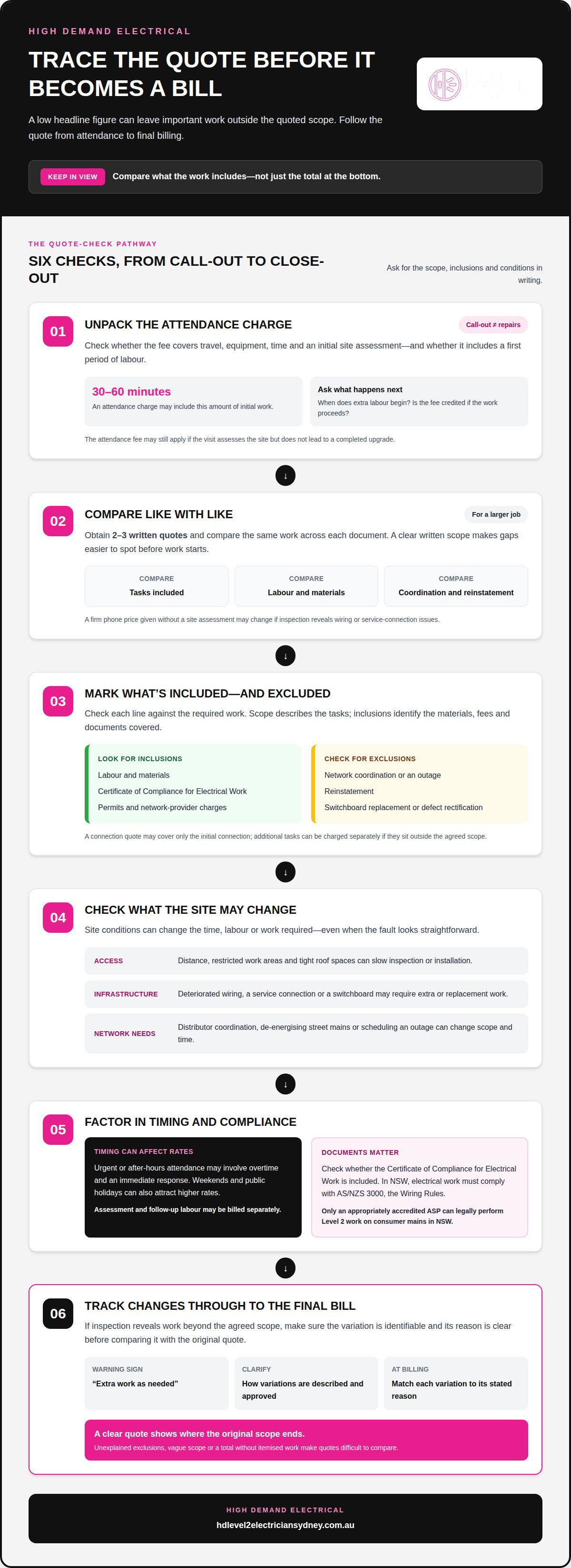
Check what the call-out fee includes, especially the first period of labour. An electrician’s attendance charge may include 30-60 minutes of work, such as inspecting a supply connection or diagnosing a fault. If the task takes longer, additional labour may apply. For example, tracing a wiring issue can take more time than a straightforward visual assessment.
An attendance fee may still apply if the initial visit doesn’t lead to a completed upgrade. It covers the electrician’s time and resources to reach and assess the site, not just the tools used for repairs. Check whether the fee is credited towards the job if work proceeds. That affects the total payable.
Travel and site access affect labour time. A distant site, restricted work area or tight roof space can slow inspection and installation. An overhead service connection may also have different access requirements from work inside a switchboard. These factors can turn a short attendance into a longer visit, even when the fault appears simple.
Urgent work can cost more than a standard daytime appointment. After-hours attendance may involve overtime and an immediate response, while weekend and public-holiday visits can also attract higher rates. If a fault requires both assessment and follow-up work, the attendance charge and later labour may be billed separately.
Before work proceeds, the written estimate should make the call-out conditions clear: what the fee covers, when extra labour begins, and whether travel or urgent attendance adds a charge. It should also distinguish assessment from repairs, replacement parts or network coordination. This helps prevent a surprise when a short diagnostic visit reveals a larger Level 2 job.
For work involving a property’s connection to the electricity network, the Level 2 electrician service scope matters as much as the attendance rate. A site assessment may identify access constraints or an issue with existing infrastructure before labour is committed. Read the estimate as a breakdown of attendance, time and task, rather than relying on one headline figure.
Fixed-price quotes and possible extras
A quote should state whether certificates and network-provider charges are included. Switchboard upgrades, service-line repairs and defect rectification may add work if site conditions reveal issues beyond the agreed scope.
In Sydney, compare the work described, not just the headline total. A quote that excludes network coordination or reinstatement may not cover the same work as a more detailed quote.
Written and comparable quotes
A written quote records the proposed work, its inclusions and any conditions that could change the total. For a larger electrical job, obtain 2-3 quotes and compare the same scope across each document. This makes gaps easier to spot before work starts.
Check that each quote explains the labour, materials, network coordination and reinstatement involved. A firm price given over the phone without a site assessment may change if inspection reveals issues with the wiring or service connection.
Quote scope and inclusions
Quote scope describes the tasks included in the price, while inclusions identify the materials, fees and documents covered. Compare each line against the required work, including whether a Certificate of Compliance for Electrical Work, permits or network-provider charges are included or excluded.
A connection job may need distributor coordination or an outage, while an older switchboard may need replacement before the agreed work can proceed. If the quote covers only the initial connection, these tasks may be charged separately. Clear exclusions show where the original scope ends.
Factors affecting quotes
Electrician quotes reflect the site, access, materials and coordination required for the particular job. In Sydney, local demand, distance between jobs and access to materials can affect pricing. Difficult access or deteriorated infrastructure can also increase labour or require replacement work.
For example, a service-line repair may involve more than replacing a visible component if the point of attachment is deteriorated. Some Level 2 jobs also involve a distributor attending, de-energising street mains or scheduling an outage. These requirements change the scope and time involved.
Quote and billing warning signs
A vague scope, unexplained exclusions or a total without itemised work makes a quote difficult to compare. Treat phrases such as “extra work as needed” as a prompt to clarify how variations will be described and approved before work proceeds.
During billing, compare each variation with the original scope and its stated reason. A switchboard upgrade or defect rectification should appear as identifiable work, not an unexplained addition. For a written estimate covering your Level 2 electrical work, send through your quote request.
Certificate of Compliance Electrical Work
A Certificate of Compliance for Electrical Work records completed electrical work, while NSW electrical work must comply with AS/NZS 3000, the Wiring Rules. In NSW, only an appropriately accredited ASP can legally perform Level 2 work on consumer mains; unlicensed or substandard work can be unsafe, poorly completed and costly to rectify.
Compliance affects the full job cost, not just the electrician’s labour. Work that fails inspection may need correction, potentially wiping out the original saving.
Electrical compliance certificates
A Certificate of Compliance for Electrical Work records the electrical work completed and its compliance. It gives you a record of the job’s scope and outcome.
For Level 2 work, the certificate belongs in the conversation about the quote and completion paperwork. A low upfront figure can create a surprise if compliance documentation is treated as an extra or omitted. If work fails inspection, the customer may have to pay for it twice, including the cost of correcting the original work.
Wiring Rules compliance
AS/NZS 3000, known as the Wiring Rules, sets the compliance standard for electrical work in NSW. Work that does not meet the standard can create unsafe conditions or require rectification before the installation is acceptable.
Requirements vary across different types of work, from switchboard changes to consumer mains. NSW residential properties must also have safety switches on all power circuits. If a job reveals a gap in the existing installation, addressing it may change the work required and the final cost.
Level 2 credentials matter because the work can involve infrastructure between a property and the electricity network. A general electrical qualification alone does not replace the appropriate ASP accreditation for consumer mains work in NSW. Accreditation is the relevant legal requirement for that Level 2 task.
Project size and complexity affect the compliance work involved. A contained repair differs from work involving consumer mains, a switchboard and network coordination. The electrician needs to account for the installation’s condition and the work required, not just the visible fault.
For example, a planned connection may uncover a switchboard that needs upgrading before the work can proceed. The additional scope can involve equipment, labour and further checks. Switchboard upgrades are a distinct part of the job, so the quote should separate them from the original Level 2 work.
Electrical work cannot be completed as a DIY project by someone without the required qualifications, and it won’t be certified. Substandard work can leave wiring unsafe or incomplete, fail inspection and need correction. A clear quote sets out the compliance work, certificate and any identified rectification, so the price reflects the full task rather than only the initial request.
Emergency and after-hours premiums
An urgent Level 2 fault outside standard hours can cost more than a scheduled residential appointment. Standard electrician hours are described as Monday to Friday, 7am-5pm; attendance outside that window may attract an overtime premium. The charge reflects when an electrician must attend, not simply how long the repair takes. A brief fault assessment can still require urgent mobilisation.
Emergency work and planned work serve different purposes. If a fault cuts power to a home or affects its supply, the immediate priority may be making the site safe or assessing what restoration requires. A full repair or upgrade may involve separate work afterwards. The quote should distinguish urgent attendance from follow-up work, so the first charge isn’t mistaken for the complete job cost.
After-hours hourly rates may apply on evenings, weekends and public holidays. The premium can depend on the timing of attendance and the work involved. For example, a night call-out to investigate a damaged service connection may require more than an inspection if the electrician identifies a fault requiring further work. The final charge depends on the job and is set out after a quote request; timing, scope and network coordination affect it.
Power restoration can also involve the electricity distributor. Some Level 2 jobs require the distributor to attend, de-energise street mains or schedule a supply outage. That coordination can affect when the work proceeds and what the job includes. A residential customer should distinguish the electrician’s attendance from any network-related requirements in the quoted scope, rather than assuming one charge covers every part.
When the immediate issue is a loss of supply, restoring power may not include every planned replacement or upgrade. The electrician assesses the fault and the work needed to address it. If a damaged connection or other infrastructure issue requires further work, the scope may extend beyond restoring power. A written breakdown helps separate urgent response tasks from later work.
Before approving emergency work, clarify what the attendance charge covers, how labour is billed, and whether a return visit or distributor coordination is included. Ask for the urgent task and follow-up work to be listed separately. This helps distinguish restoring a safe supply from completing a broader electrical project, without assuming an after-hours attendance includes a fixed-price repair.
Emergency and after-hours Level 2 electrical work carries a premium compared with standard daytime appointments. The quote should make the applicable attendance scope clear.
Factors affecting Level 2 electrical work costs
Two Level 2 jobs can require different labour, materials and network arrangements, even when both involve a property supply connection. In Sydney, the main cost drivers are the work method, site conditions, existing infrastructure and coordination the job needs. Understanding these factors helps explain why a low initial price may not represent the complete scope.
Level 2 fees and requirements vary by jurisdiction, including the applicable accreditation and electricity network processes. In NSW, only an appropriately accredited ASP can legally perform Level 2 work on consumer mains; relevant distributors include Ausgrid, Endeavour Energy and Essential Energy.
The installation method changes the work involved. In Sydney, overhead Level 2 work is generally quicker and cheaper than underground work. An underground mains installation can take multiple days, while an overhead job may involve different access and connection requirements. The route, property layout and existing infrastructure help determine the work needed.
Existing conditions can also expand the scope. Difficult access or infrastructure that needs upgrading can increase the labour and materials required. For example, a connection job may reveal deteriorated consumer mains, or restricted access may make installation more involved. The quote needs to reflect the actual work, not only the requested outcome.
Time varies by job type and complexity. Wiring connection jobs in Sydney usually take at least two hours, while extensive projects, such as upgrading overhead service lines or relocating power connections, can take several days or even weeks. An underground installation may also take multiple days. The expected duration affects labour planning and the resources needed to complete the work.
Commercial sites may involve more complex systems, higher voltage requirements and additional safety procedures than standard residential work. Work requiring specialised skills or experience generally costs more. The number of circuits, how they connect to the supply and the site’s operational requirements can all affect the work plan. These factors distinguish a straightforward residential connection from a complex commercial project.
For Level 2 work, pricing depends on the site and scope and is provided after a quote request. The key factors are access, installation method, existing infrastructure, job duration and network coordination. A licensed electrician assesses these details to define the work required. Comparing the stated scope against the site conditions helps reveal whether a quote covers the necessary work or only part of it.
If a supply connection or infrastructure issue needs assessment, request a quote for your Level 2 electrical work. Include the property location, the issue or planned work, and any known access constraints. Those details help establish the relevant scope and factors affecting the job.
High Demand Electrical: Level 2 ASP Electrical Services
High Demand Electrical provides Level 2 ASP Electrical Services for Sydney properties needing work on electrical supply infrastructure. This is the relevant next step when a connection issue, consumer mains or private power pole requires specialist attention. The service can also help when a property needs a switchboard upgrade or Tesla and home EV charger installation.
The scope and price depend on the site, existing infrastructure, access and any network coordination required. A clear quote request helps define the work and identify relevant inclusions before it proceeds.
For help with a Level 2 electrical project, contact High Demand Electrical to discuss the work required.
Make your next electrical decision with clarity
The hidden costs of cheap Level 2 electrical work are easier to manage when the decision starts with the property’s actual needs, not just the initial figure. Before proceeding, consider how the proposed work fits your plans for the site, whether it addresses the underlying issue, and what information you need to make a confident decision.
A clear scope gives you a basis for understanding and discussing the project. If site conditions or the intended outcome have changed since the estimate was prepared, raise this before work begins so the proposed scope can reflect the current situation. Making informed, independent choices is an essential part of managing complex property decisions; exploring how personal control works, as outlined by New Age Psychiatry, can offer helpful perspective on intentional decision-making.
High Demand Electrical can discuss Level 2 electrical work for your property and help clarify the next step. Contact High Demand Electrical about your project to start a conversation. A considered decision now can help you move forward with greater confidence.
Frequently Asked Questions
What is included in a cheap Level 2 electrical service quote in Australia?
There’s no single standard bundle included in every Level 2 quote. The written scope should identify the specific work, labour, materials and any network coordination, then state what is excluded. For example, a quote for a connection may not include repairs to an existing installation if those repairs fall outside the described task. Treat a low total as a starting point for understanding scope, not proof that every required task is covered.
What extra charges can apply for after-hours or emergency Level 2 electrical work?
After-hours, weekend and public-holiday attendance may attract higher rates because of overtime and the need for an immediate response. The total may also depend on whether the visit is for an initial assessment, urgent make-safe work or further repairs. For example, restoring supply after a fault may involve separate work to fix the underlying issue. The quote should distinguish urgent attendance from follow-up tasks so you can see what each charge covers.
What warranties and insurance should Level 2 electrical contractors provide in Australia?
For NSW residential electrical work valued over A$5,000, statutory warranties provide two years of coverage for minor defects and six years for major defects. A warranty and insurance serve different purposes, so don’t treat one as a substitute for the other. High Demand Electrical holds EC Licence 397193C and is a Level 2 Accredited Service Provider (ASP) - authorised for service line, metering and connection work for Ausgrid, Endeavour Energy and Essential Energy.
How can homeowners compare Level 2 electrical quotes and identify hidden fees?
Give each electrician the same description of the job, then compare the deliverables, assumptions and exclusions in each quote. Check how variations are handled if site conditions differ from expectations, and whether optional work is separated from the required task. For example, an estimate based on visible conditions may change if inspection uncovers an issue behind existing equipment. Keep the accepted quote and any written variation together to track what was agreed.
Need Help Fast?
Powering Your Needs with Expertise
If you’re looking for a reliable, experienced, and prompt electrician, look no further than High Demand Electrical. We cater to all your electrical needs, from routine maintenance to emergency repairs and complete system installations. Our skilled team is committed to providing professional service that ensures your electrical systems run smoothly. Whether it's a small task or a large project, give us a call today. Let us meet all your electrical demands with the quality and reliability you deserve.

Licensed Level 2 ASP electricians across Sydney. Same-day service and 24/7 emergency response.
Licence 397193C
ABN 87 051 836 527
