Ausgrid electrical safety rules for electrical work in Sydney
The key safety question is whether the work affects Ausgrid’s network. The Ausgrid electrical safety rules set requirements for employees, contractors, subcontractors and others working on or near the network, including near substations and electrical equipment owned by other organisations.
It’s understandable to look for one set of rules that covers every electrical job in Sydney, but the requirements depend on the work and the network involved. Ausgrid’s rules were amended in 2022 and sit alongside NSW regulations, so understanding their scope helps clarify which requirements apply.
This article explains what the rules cover, how they relate to the NSW regulatory framework, and what to consider around substations, overhead powerlines and other organisations’ apparatus. You’ll also see where Level 2 ASP electrical services fit when work involves Ausgrid’s network.
Key Takeaways
• Understand who the rules apply to and the work they govern on or near Ausgrid’s network.
• See how the 2022 amendments fit alongside the NSW regulatory framework.
• Learn why work near substations and other organisations’ apparatus calls for particular care and attention to warning signs.
• Know the essential precautions around overhead powerlines, including what to do if a wire has fallen.
• Find out when Level 2 ASP electrical services may be relevant to work involving network infrastructure.
Amendments to the ESR
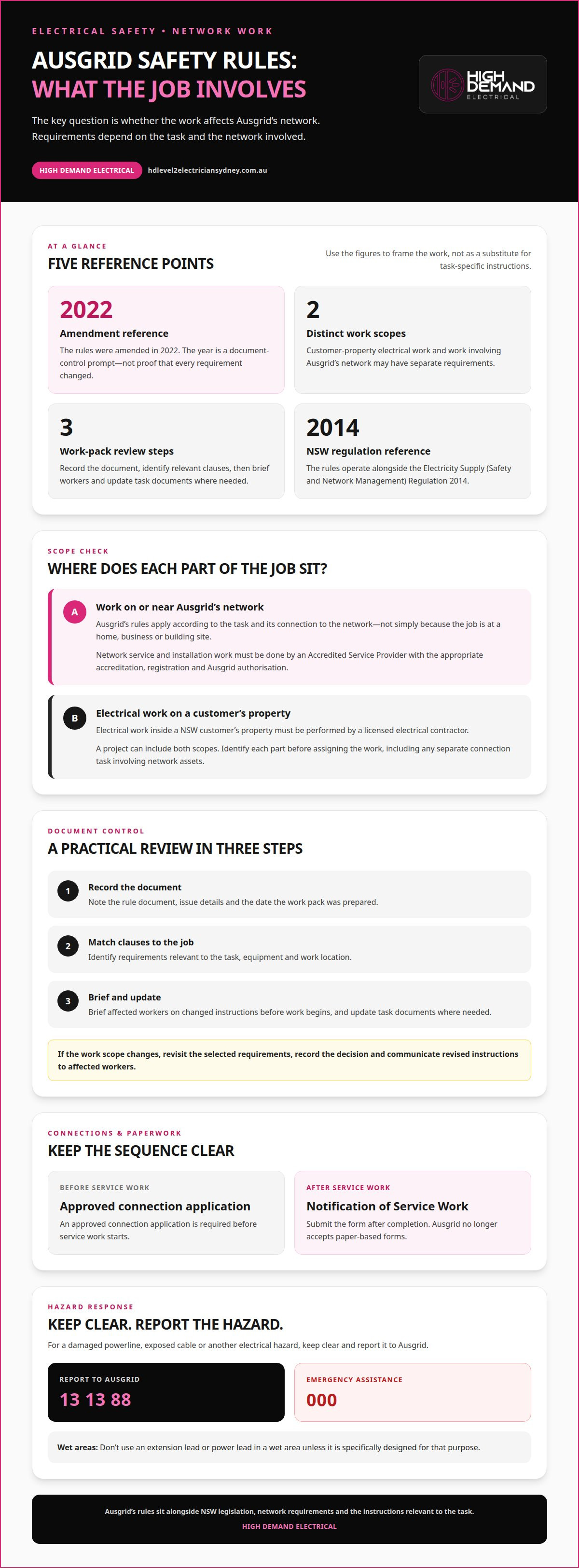
2022 is the year identified for amendments to Ausgrid’s Electrical Safety Rules. The Ausgrid electrical safety rules affect how work on or near its network is planned and carried out. For a project team, the amendment year is a useful document-control reference. It does not identify which clauses changed or mean that every requirement was replaced.
Start a work pack by recording the rule document and issue used for planning. Then make sure the people preparing and carrying out the task use the same material. If workers rely on different versions, they may plan the same activity against different instructions. This can create confusion about procedures, controls or responsibilities before work begins.
Link the relevant requirements to the actual job. For work involving electrical equipment, identify the equipment and work area, then point workers to the applicable instructions. A general note such as “follow the latest rules” does not identify a specific clause or procedure. Consider the Ausgrid electrical safety rules alongside the job details, not as a generic checklist.
A practical amendment review can follow this sequence:
• Record the document title, issue details and the date the work pack was prepared.
• Identify clauses relevant to the task, equipment and work location.
• Brief affected workers on changed instructions before work begins, and update task documents where needed.
These document-control steps don’t replace Ausgrid’s requirements or interpret a clause for a particular job. If an instruction is unclear, resolve its meaning before relying on it for a safety decision. The year 2022 is a reference point, not proof that a particular method, control or authorisation applies to every task.
Keep the review aligned with the work scope. If the scope changes after planning, revisit the requirements selected for the original task. Record the decision and communicate any revised instructions to affected workers. This makes it easier to trace which rules informed the plan and helps avoid relying on controls chosen for a different activity.
For a Sydney project, record the network area separately from the work location. The local context is outlined in this guide to electrical work in Sydney. Use the amendment year to prompt a review of controlled, task-relevant instructions, not as a shortcut for interpreting an individual clause.
Purpose and scope of Ausgrid’s Electrical Safety Rules
The rules apply to work on or near the Ausgrid network, including work by Ausgrid employees, contractors, subcontractors and others working on network assets. Whether they apply depends on the task and its connection to the network, not simply on whether the job is at a home, business or building site.
For a homeowner or builder arranging solar or generator work, requirements depend on whether the job involves Ausgrid’s network. Network service and installation work must be carried out by an Accredited Service Provider with the appropriate accreditation, registration and Ausgrid authorisation. Electrical work inside a NSW customer’s property must be performed by a licensed electrical contractor.
A project may include both electrical work on the property and network-related work. For example, a solar installation may involve work on the customer’s system as well as a separate connection task involving network assets. The Ausgrid electrical safety rules apply to the network portion, while property work has its own applicable requirements. Identify each part of the project before assigning the work.
If you find a damaged powerline, exposed cable or another electrical hazard, keep clear and report it to Ausgrid on 13 13 88. For emergency assistance, call 000.
For current procedures, forms and emergency contact details, refer to Ausgrid’s published rules and official service information. After service work, submit the Notification of Service Work form; Ausgrid no longer accepts paper-based forms. For planning, consider the Ausgrid electrical safety rules alongside the work instructions and network procedures relevant to the task.
For example, when arranging a service connection, distinguish the customer-side installation from work on the network. This helps identify the appropriate worker, authorisation and paperwork for each part. An approved connection application is required before service work starts, and the Notification of Service Work form is submitted after completion. Keeping these stages clear supports an organised handover.
Electrical work on a property and network service work are separate scopes. A builder arranging site work should define the planned connection, identify tasks that affect Ausgrid assets and assign each part appropriately. This gives the project team a clear basis for coordinating the work and its documentation.
For connection work involving Ausgrid’s network, contact the team about Level 2 ASP electrical services to discuss the network-related work and its scope.
Adhering to these safety principles also helps keep attention on the conditions in which equipment is used. Extension leads or power leads should not be used in wet areas unless they are specifically designed for that purpose. When a task involves a wet area, treat the suitability of any lead as a point to check before use, rather than assuming that a lead suitable elsewhere is suitable there. Keep this consideration tied to the conditions of the task. If a lead is not specifically designed for use in a wet area, do not use it there.
Regulatory framework
Ausgrid’s Electrical Safety Rules operate alongside NSW legislation and network requirements. They assist workers to comply with the Electricity Supply (Safety and Network Management) Regulation 2014, which the rules describe as an industry standard they meet. The regulation also sets requirements for low-voltage live work, so workers must consider those requirements alongside the relevant Ausgrid procedures.
Contestable work has a separate legislative reference: the Electricity Supply (General) Regulation (2001). The applicable framework depends on the work’s connection to the electricity network. A useful first step is to identify whether the job is work inside a customer’s property, contestable service work, or work on or near Ausgrid’s network. That classification helps identify which rules, authorisations and procedures apply.
For electrical work inside a customer’s property in NSW, the work must be carried out by a licensed electrical contractor under the Gas and Electricity (Consumer Safety) Act 2017 and Regulation. Service and installation work on or near Ausgrid’s network has an additional accreditation and authorisation requirement. Companies, workers and subcontractors must be accredited and/or registered, and authorised by Ausgrid as an Accredited Service Provider at the appropriate level and class.
Accredited Service Providers must complete appropriate training and register with the ASP scheme. These requirements relate to a worker’s authority to perform network work and are separate from a general electrical licence. First establish the job scope and its connection to the network, then ensure each person has the applicable status and authorisation.
Vegetation work also has specific limits. Under the Electricity Supply (Safety and Network Management) Regulation 2014, vegetation management within the minimum safe working distances of an ordinary person must use only methods specified in Ausgrid’s rules. A tree or branch near electrical wires should therefore not be treated as ordinary gardening. The work method must fit the rules that apply to the location and task.
Use this practical sequence to organise compliance before work starts:
• Define the task, worksite and whether Ausgrid network assets are involved.
• Identify the applicable NSW regulation and Ausgrid requirements for that work.
• Confirm the required ASP accreditation, registration, authorisation and training for network tasks.
• Apply the relevant procedures to low-voltage live work or vegetation management where those activities form part of the scope.
This sequence helps distinguish property electrical work from network service work, with each subject to its own requirements. If a project involves both, document the separate scopes and responsibilities. This clarifies the applicable regulatory pathway for those planning and carrying out the work.
Work near substations and other organisations’ apparatus
Substations, overhead lines and buried cables present different hazards. Identify the electrical equipment and task before planning. Warning signs such as “Danger”, “Keep Out” and “High Voltage” mean stay away.
Working Near Overhead Powerlines
Ausgrid’s safe approach distances apply to people, vehicles and equipment near overhead lines. Use the distance appropriate to the line and task; do not guess or assume one clearance suits every situation. Ladders, scaffolding, cranes and elevated work platforms can bring people or equipment close to wires, so plan their position and movement against the applicable requirements.
For fallen wires, stay at least 8 metres away. Ausgrid also advises looking up before moving ladders or sailing boats, and keeping kites, drones and model aircraft away from overhead wires.
Digging Near Underground Cables
Before excavating, check for underground cables, including around a home. Do not assume a cable runs in a straight line from visible electrical equipment or that a familiar digging area is clear. Locate and identify Ausgrid equipment before breaking ground, then plan the excavation around its position.
Ausgrid’s WebGIS information system is restricted to ASP Level 2 workers specifically authorised to access it. A person without that authorisation must not treat WebGIS as an available locating tool; cable location still needs to be established before digging proceeds.
Permits and Approvals
The approval pathway depends on the work and the apparatus affected. Electrical contractors should have an approved Ausgrid connection application before undertaking service work. Companies, workers and subcontractors doing service or installation work on or near Ausgrid’s network must hold the appropriate accreditation and/or registration, and Ausgrid authorisation for the relevant level and class.
Work near another organisation’s equipment also requires identifying the network asset and applying the relevant controls. Do not assume Ausgrid approval covers equipment owned by another organisation. Define the work area and identify the equipment before work starts.
Responding to Powerline Contact
If a person or vehicle contacts a powerline, keep clear and prevent others from approaching. Don’t touch the wire, vehicle or person while they may be in contact with live electrical equipment. Call 000 for emergency assistance, then report the electrical hazard to Ausgrid on 13 13 88, whose phone service operates 24 hours.
If the wire has fallen, maintain the 8-metre separation and treat it as live. Near a substation, obey warning signs and stay outside the restricted area rather than attempting to retrieve objects or approach equipment.
What are Ausgrid's electrical safety rules for working near overhead powerlines?
Overhead lines can pose hazards during everyday activities and planned work. Ausgrid advises people to keep clear, look for wires before moving tall equipment, and seek professional advice if trees or branches are near electrical wires or connections.
There isn’t one safe approach distance that can be applied to every person, vehicle and piece of equipment. Use the distance required for the specific work under Ausgrid’s rules; don’t estimate clearance by eye. For a fallen wire, stay at least 8 metres away and treat it as live, including after a storm.
Plan the work area before bringing equipment onto a site. Look overhead for powerlines before positioning a ladder, moving a sailing boat or setting up a trampoline. Keep kites, drones and model aeroplanes away from overhead wires, and never climb a tree near powerlines. These precautions help prevent people or objects from getting close to a conductor during routine activities.
Tiger tails make electrical wires easier to see, but do not insulate them or provide full protection from live electricity. Treat a covered wire as hazardous and maintain the required clearance. If house painting brings someone close to electrical wires, Ausgrid advises avoiding contact and arranging tiger tails through Ausgrid if necessary.
For trees and branches, don’t attempt work close to a wire or connection without professional advice. Ausgrid’s guidance is to seek that advice when vegetation is near or touching electrical wires. The work method matters too: for vegetation management within the minimum safe working distances of an ordinary person, only methods specified in Ausgrid’s rules may be used under the Electricity Supply (Safety and Network Management) Regulation 2014.
Keep these checks in mind before an activity near overhead lines:
• Look up before carrying or raising ladders, and before moving sailing boats.
• Choose open play areas away from poles, towers and overhead powerlines.
• Keep trampolines, kites, drones and model aircraft well away from wires.
• Stay clear of fallen wires, maintaining at least 8 metres of separation.
• Do not treat tiger tails as insulation or permission to approach a wire.
For work involving overhead service connections, arrange qualified support before the task begins. Discuss overhead powerline work with the electrical team before positioning people or equipment near the lines.
Before starting an activity, Ausgrid advises looking up for powerlines when using ladders or moving sailing boats, and avoiding going near them. Whenever possible, people should choose open spaces for play, away from electricity poles, towers and power lines. Ausgrid also advises setting up trampolines and other equipment well away from powerlines. Consider these points when choosing where an activity will take place and where equipment will be set up; keep the intended activity and the equipment clear of overhead lines.
Where guttering needs replacing or cleaning near electrical wires or connections, Ausgrid advises using a wooden stick or broom handle, and says a wooden ladder is preferable. After a storm, people should stay well clear of fallen power lines because they may still be live. Keep that caution in mind even after the storm has passed: a fallen line may still be live, so maintain distance rather than approaching it.
High Demand Electrical
High Demand Electrical can help when electrical work involves Ausgrid network infrastructure or service connections. Its Level 2 ASP Electrical Services are relevant to network-related work, while the project scope determines which service is appropriate. Clear information about the site, the work planned and any known network issue helps define the next steps.
For property projects in Sydney, High Demand Electrical carries out switchboard upgrades, private power pole installation, and Tesla and home EV charger installation. Each service addresses a different electrical need, so match the work to the issue at the property and any network requirements.
If you’re planning electrical work in Sydney and need to discuss the scope, contact High Demand Electrical.
Plan the next step with clarity
Before scheduling work, turn the safety requirements into a practical project brief. Describe the work area, equipment, network connection and decisions that need coordination. This gives everyone responsible for planning and delivery a shared starting point, rather than leaving key details unresolved once work is underway.
High Demand Electrical supports Sydney electrical projects with Level 2 ASP Electrical Services, switchboard upgrades and private power pole installation. Each service suits different project needs, whether the work concerns a network connection, an existing switchboard or a private supply arrangement. Defining the job clearly helps identify which kind of support fits.
Use the Ausgrid electrical safety rules as part of project planning, alongside decisions specific to your site and proposed work. A clear scope helps organise the next steps and communicate responsibilities before work begins.
Contact High Demand Electrical for advice about your project and the practical next step. With the scope clearly defined, you can move forward with greater confidence.
Frequently Asked Questions
What is the Ausgrid ESR?
The Ausgrid electrical safety rules, known as the ESR, govern work on or near Ausgrid’s electricity network. They set out requirements workers use to plan network tasks and identify relevant procedures. For example, a contractor planning service work can use the Ausgrid electrical safety rules to understand the network-safety framework, while separately following the requirements that apply to electrical work inside a customer’s property.
Need Help Fast?
Powering Your Needs with Expertise
If you’re looking for a reliable, experienced, and prompt electrician, look no further than High Demand Electrical. We cater to all your electrical needs, from routine maintenance to emergency repairs and complete system installations. Our skilled team is committed to providing professional service that ensures your electrical systems run smoothly. Whether it's a small task or a large project, give us a call today. Let us meet all your electrical demands with the quality and reliability you deserve.

Licensed Level 2 ASP electricians across Sydney. Same-day service and 24/7 emergency response.
Licence 397193C
ABN 87 051 836 527
