3 Phase Outlet Installation for Workshop Equipment
Three-phase power is more than a larger socket: in Australia, it supplies electricity through three active conductors, with 400-415 volts between phases. A 3 phase outlet installation for a workshop connects compatible machinery to that supply, with the outlet, circuit protection and earthing designed as part of the electrical installation.
If you’re planning to run workshop machinery, the outlet is only one part of the job. The supply and existing electrical installation also matter, so it’s sensible to understand what the equipment needs before planning an upgrade. This article explains how three-phase power supports higher-load machinery and what a professional considers when planning an installation.
You’ll also learn how supply upgrades work, how outlets fit with circuit protection and earthing, and why machinery requirements shape the final setup. This practical context helps you understand the work and what information to provide when discussing your Sydney workshop’s electrical needs.
Key Takeaways
• Three-phase power supplies electricity through three active conductors, making it useful for workshop machinery designed to run on this supply.
• Match outlet and circuit capacity to the equipment’s requirements; common workshop three-phase outlets are rated at 20 or 32 amps.
• An upgrade can involve more than installing an outlet: the existing supply and switchboard may also need attention.
• Circuit protection and earthing are integral to a safe installation, with electrical testing forming part of the work.
• Understand how the machinery, outlet location and existing electrical infrastructure shape the installation before planning the project.
What is Three-Phase Power?
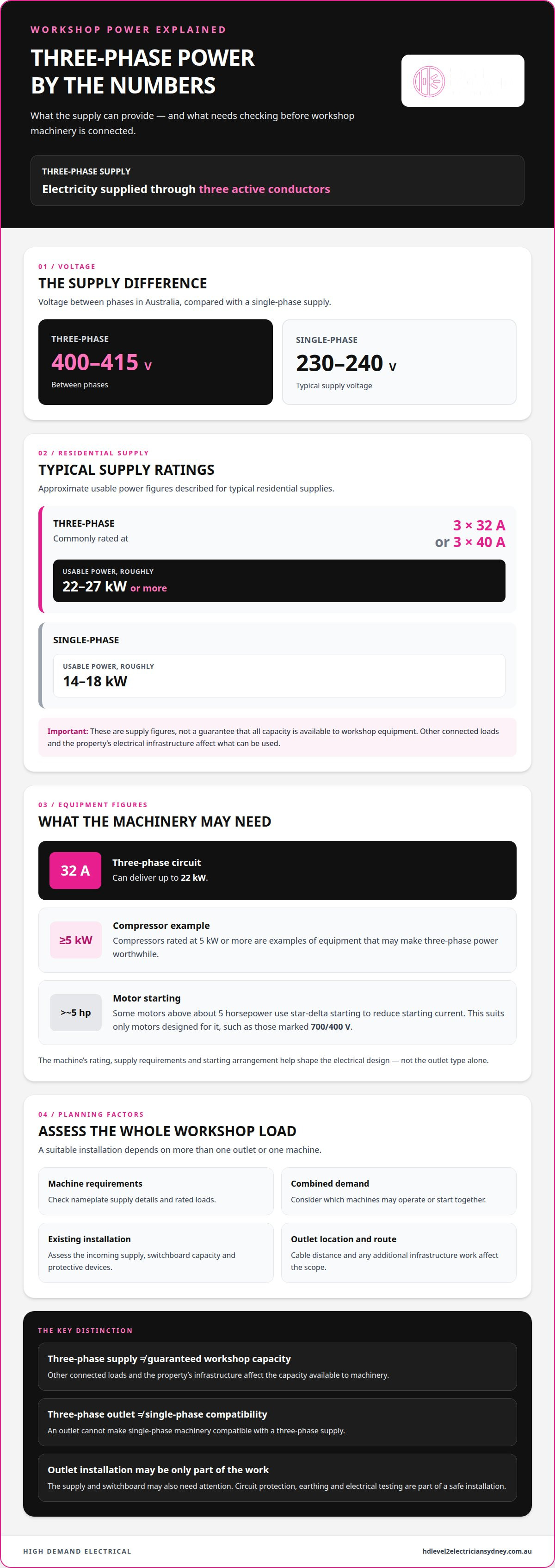
Three-phase power supplies electricity through three active conductors, with 400-415 volts between phases in Australia. By comparison, single-phase power supplies 230-240 volts. This difference matters when a workshop’s machinery is designed for a three-phase supply, or when several high-demand machines need to operate within the available electrical capacity.
A typical residential three-phase supply is commonly rated at 3 x 32 amps or 3 x 40 amps. Its usable power is roughly 22-27 kilowatts or more, compared with roughly 14-18 kilowatts from a typical single-phase residential supply. These figures describe supplies, not a guarantee that all capacity is available to workshop equipment. Other connected loads and the property’s electrical infrastructure also affect what can be used.
For high-demand equipment, the machine’s rating and supply requirements are the starting point. A 32-amp three-phase circuit can deliver up to 22 kilowatts, while compressors rated at 5 kilowatts or more are examples of equipment that may make three-phase power worthwhile. The appropriate supply and circuit depend on the machinery’s specifications and how the workshop operates. A three-phase outlet cannot make single-phase machinery compatible with three-phase power.
An electrician can assess the incoming service and switchboard to identify the supply, rather than relying on an outlet’s appearance. Supply documents or switchboard labels may also indicate whether the property has three-phase power. A visual clue alone is not reliable confirmation, so have the electrical installation professionally assessed.
Switchboard capacity is a separate question from whether three-phase power reaches the property. An assessment considers the existing supply, switchboard arrangement, protective devices and the proposed workshop load. If the board cannot accommodate the required circuits or protection, upgrade work may be needed before outlets are installed. For Sydney properties, Level 2 electrical work in Sydney can include work related to the supply connection and service infrastructure.
The scope depends on the cable route and distance, whether the switchboard needs upgrading, and whether the existing supply has enough capacity. A longer cable run or additional infrastructure work changes the job. If the supply is insufficient, a broader upgrade may be needed, not just a new outlet.
These distinctions guide 3 phase outlet installation for workshop equipment: first establish the supply, then assess the switchboard and machinery load. The outlet rating and circuit design must suit the equipment and installation, not simply the highest available supply figure. That assessment helps determine whether the workshop needs an outlet on an existing three-phase service or a wider electrical upgrade.
Three-phase power and high-load workshop equipment
Three-phase power can suit workshop machinery that requires a compatible supply or several substantial loads that may operate together. Whether it is needed depends on the equipment, how it starts and how the workshop will use it.
Powering high-load workshop equipment
Whether workshop equipment needs three-phase power depends on its supply requirements and the capacity of the existing service. This is relevant to machinery such as large motors and compressors, where the supply needs to suit both normal operation and the starting load.
For example, if a compressor and other machinery may run at the same time, assess their combined loads, not just the largest machine. Motor nameplates show supply requirements, while the operating sequence indicates whether machines could start together. These details help establish whether an upgrade is needed and how to arrange the circuits.
Benefits of three-phase power
Three-phase power distributes the supply across three active conductors and can support equipment designed for that arrangement. In a workshop, it can provide a practical way to run compatible motors and several higher-demand machines without relying on a single-phase circuit for every load.
Motor starting also matters. Some motors above about 5 horsepower use star-delta starting to reduce starting current. That method suits only motors designed for it, such as those marked 700/400 volts. The motor’s plate and starting arrangement therefore influence the electrical design, rather than the outlet type alone.
Three-phase power has limits. It does not increase a machine’s rated output or make single-phase equipment compatible with a three-phase supply. The property’s available supply, switchboard capacity and other connected loads still set practical limits. If the workshop’s existing supply can meet the actual demand, an upgrade may not be necessary.
Before planning a 3 phase outlet installation for a workshop, the electrical assessment considers each machine’s supply details, expected use and starting method. It also considers which machines run at the same time, where equipment sits, and whether future machinery could change the demand. This prevents a design based solely on one machine while overlooking the workshop’s wider operating needs.
Three-phase power is most relevant when specified machinery requires it or the existing service cannot meet the workshop’s combined demand. If supply infrastructure needs attention, a discussion about your workshop’s electrical requirements can help clarify the next steps.
Three-phase upgrade process and approvals
A three-phase upgrade can involve the property supply, switchboard, new circuit and workshop outlet. For a Sydney workshop, an electrician assesses these together because installing an outlet alone may not provide the supply the machinery needs.
Installation and testing steps
The electrician establishes the machinery’s requirements, the outlet position and the existing supply arrangement. They assess whether the supply and switchboard can support the proposed circuit, then identify any upgrade or connection work required. This ensures the outlet design suits both the equipment and the property’s electrical infrastructure.
After installing the circuit, the electrician tests the work. Checks include earthing continuity, insulation resistance, polarity, circuit connections, fault loop impedance and RCD operation. Each test assesses a different part of the installation, from protective earthing to the response of safety devices.
If the property needs a supply change, the project may extend beyond the workshop circuit. A single-phase to three-phase upgrade changes the supply, while the outlet connects compatible machinery to the upgraded arrangement. Connection requirements and site conditions shape the sequence of work.
Licensed electrician requirements
Fixed wiring, switchboard connections and workshop outlet installation require an appropriately licensed electrical contractor. This work involves live electrical infrastructure, circuit connections and protective measures, not simply plugging in machinery. The contractor assesses and tests the completed installation.
Network-connected supply work also has its own requirements. In Sydney, the scope depends on the existing service and whether the upgrade affects the property’s connection to the electricity network.
Standards and state or territory rules
For Sydney installations, the applicable framework includes AS/NZS 3000, the Australian and New Zealand Wiring Rules, and the Service and Installation Rules of NSW (SIRNSW). These guide electrical installation and service connection requirements. The work’s scope determines which requirements apply to the outlet, switchboard and supply connection.
Network-connected work may need to meet the relevant distributor’s requirements. The electrician considers these alongside the workshop circuit design, installation and testing, so the outlet is planned as part of the wider electrical arrangement, not as a separate socket fitting.
For a Sydney workshop, the process starts by assessing the machinery and existing supply, then establishing the required circuit and any associated upgrade work. Testing follows installation to assess the completed electrical arrangement.
Queensland work follows requirements that differ from those for the Sydney installation. Fixed wiring, switchboard work and three-phase upgrades in Queensland must be carried out by a licensed electrical contractor. Queensland three-phase installations must comply with the Queensland Electrical Safety Act and Energex requirements. A three-phase power installation in Australia usually takes 5-7 weeks from application to final connection.
The connection process also has a service-work step. The connection process may include service-work notification requirements. The Electricity Act 1994 is the legislation cited for connection services performed by accredited service providers in Queensland. Considering these requirements alongside the wiring and switchboard work helps account for both the property installation and the service connection when planning the project.
Workshop circuit protection and earthing
A three-phase workshop outlet needs protection suited to its circuit, connected machinery and installation. Earthing and protective devices work together: earthing provides a path for fault current, while circuit protection helps limit electrical hazards. Both are essential parts of the installation.
The required capacity and protection depend on the equipment’s rated supply and current, the circuit design and other workshop loads. The electrician selects the circuit and protective devices as a coordinated system, rather than choosing them based on the outlet face alone.
Overcurrent protection and residual current device (RCD) protection address different risks. Overcurrent protection responds to excessive current, while an RCD monitors current imbalance. An RCD alone does not provide overcurrent protection. For example, a type AC RCD without overcurrent protection cannot perform both functions by itself, so the circuit design must provide for each protective function.
Earthing continuity matters if a fault energises an exposed conductive part of machinery or its enclosure. The earthing system provides a path for fault current, helping protective devices operate. A damaged or discontinuous earth connection can undermine this protection, so an electrician tests the earth path rather than relying on a visual check.
Testing assesses the installation as a complete circuit. The six checks include:
• Continuity of the earthing system
• Insulation resistance
• Polarity
• Circuit connections
• Fault loop impedance
• RCD operation
Each result addresses a different part of the installation. Insulation resistance checks the condition of insulation, while polarity and circuit connection tests help establish correct wiring. Fault loop impedance testing assesses the fault path, and an RCD operation test checks that the device responds as intended. Earthing continuity testing confirms the protective earth connection throughout the installation.
Workshop conditions also affect the protection design. Machinery with variable-speed drives, motors or several operating modes may have electrical characteristics that influence device selection. The circuit arrangement needs to suit both the equipment and the installation, rather than simply copying protection used elsewhere in the building. Safety switch installation is relevant when RCD protection forms part of the required arrangement.
These checks give the electrician a documented basis for assessing the completed work. Correct capacity, coordinated protection, sound earthing and six installation tests help assess the new workshop circuit as a system, not just a socket connected to power.
One contributor reported that the workshop had 30mA RCD protection for the whole house and was considering a 10mA RCD for the workshop. This is a reported consideration, not a general selection rule: the protection arrangement must still suit the workshop circuit, equipment and installation. The workshop owner also identified the purchased RCD as type AC and said it had no overcurrent protection. Those details underline why a device should be assessed as part of the complete circuit, rather than treated as a complete protective arrangement on its own. An electrician can assess the existing protection and verify whether the proposed arrangement provides the required protective functions.
Three-phase workshop machinery and outlets
The outlet rating needs to suit the machinery, circuit and electrical design. Matching these parts helps the equipment connect and operate as intended.
Choosing an outlet rating
A licensed electrician selects a rating by comparing the machine’s electrical requirements with the circuit design. For a 10 A, 15 A, 20 A or 32 A outlet, the equipment nameplate, plug and expected operating load all matter. The selected rating must suit the connected equipment and the circuit supplying it.
This assessment also considers the cable run, circuit protection and whether other equipment shares the circuit. A rating cannot be chosen from the machine’s physical size or the outlet’s appearance. For example, a machine with a 20 A connection needs a compatible outlet and circuit arrangement, not simply a socket that fits nearby.
Matching outlets to workshop machinery
The machinery’s rated supply, current requirements and connection method determine the appropriate outlet. A fixed machine and one that uses a plug connection may need different arrangements, even if both use three-phase power. The electrician uses the manufacturer’s details to specify a suitable outlet and circuit.
Common workshop three-phase outlets are rated at 20 or 32 amps. An existing 16-amp socket may not suit a machine requiring a different rating. The electrician assesses the machine and circuit together, rather than treating a socket change as sufficient.
The physical layout matters too. Position the outlet so the machine can connect without straining the lead or obstructing movement around the workshop. The electrician considers where and how the equipment will be used, and whether a fixed connection or outlet is suitable.
Consider each machine separately. A workshop might have a compressor and another machine, each with different connection requirements. The electrician assesses their ratings and whether they could operate at the same time. This helps determine whether to arrange separate circuits and whether the existing supply can support the intended use.
Compatibility involves more than the amp rating. The equipment’s phase requirements, connector arrangement and circuit protection must align. A three-phase outlet does not convert equipment designed for single-phase power, and a higher-rated outlet does not increase a machine’s capacity. The machinery’s specifications remain decisive.
For a 3 phase outlet installation for workshop machinery, the practical takeaway is to design around the equipment, not a preferred socket size. Arrange a workshop outlet assessment to match the machinery’s connection requirements with the electrical installation.
High Demand Electrical
High Demand Electrical can help workshop owners understand whether supply infrastructure or the switchboard needs attention before three-phase equipment is connected. Its Level 2 ASP Electrical Services address electrical infrastructure, while Switchboard Upgrades can help where the existing board needs work to support an updated installation.
Turn to High Demand Electrical when an assessment points to a supply upgrade, switchboard work or other infrastructure requirements. The right scope depends on the workshop’s existing electrical arrangement and the machinery’s requirements, so the next step is to discuss those details with the team.
Contact High Demand Electrical to discuss your workshop’s electrical needs.
Plan the next step for your workshop
A 3 phase outlet installation for your workshop should fit the way the space operates, not just the machinery you’re connecting today. Consider how equipment may be rearranged or added, and include those plans when discussing the electrical scope. That gives the assessment a useful view of both current needs and future workshop use.
High Demand Electrical can help with infrastructure requirements through Level 2 ASP Electrical Services, Switchboard Upgrades and Private Power Pole Installation. These offerings are relevant when the project involves more than the outlet itself, such as switchboard work or power infrastructure. The appropriate work depends on the property and the installation being planned.
Contact High Demand Electrical to discuss your workshop’s electrical requirements and take the next step with a clear understanding of the work involved.
Frequently Asked Questions
What is a three-phase outlet and how is it used in an Australian workshop?
A three-phase outlet provides a connection point for machinery designed to use a three-phase supply. In a workshop, an electrician matches the outlet and circuit to the equipment’s connection requirements. For example, a machine with a three-phase plug needs a compatible outlet and supply. The outlet itself does not convert a single-phase supply or change the machine’s electrical requirements.
What three-phase outlet types, pin configurations and amperage ratings are common in Australia?
Common workshop three-phase outlets are rated at 20 or 32 amps. The correct pin arrangement and outlet rating depend on the machinery’s plug and electrical requirements, so there isn’t one configuration that suits every workshop machine. An electrician assesses the equipment and circuit together. A 10 A or 15 A rating should not be assumed suitable just because it is available; compatibility must be established for the specific equipment.
What safety risks and precautions apply when using three-phase power in a workshop?
Key risks include electric shock from an electrical fault and inadequate protection if the circuit or earthing is unsuitable. Have the protective devices and earth connection assessed for the equipment and circuit. Electrical testing includes earthing continuity and RCD operation. Keep damaged equipment out of service and have electrical faults assessed by a licensed electrician. Don’t rely on the outlet’s appearance or the fact that a machine still runs.
Need Help Fast?
Powering Your Needs with Expertise
If you’re looking for a reliable, experienced, and prompt electrician, look no further than High Demand Electrical. We cater to all your electrical needs, from routine maintenance to emergency repairs and complete system installations. Our skilled team is committed to providing professional service that ensures your electrical systems run smoothly. Whether it's a small task or a large project, give us a call today. Let us meet all your electrical demands with the quality and reliability you deserve.

Licensed Level 2 ASP electricians across Sydney. Same-day service and 24/7 emergency response.
Licence 397193C
ABN 87 051 836 527
